

You don't need to rebuild your portfolio to show you can design with AI. You need to find the one place in each case study where AI actually belongs, and explain why it belongs there.
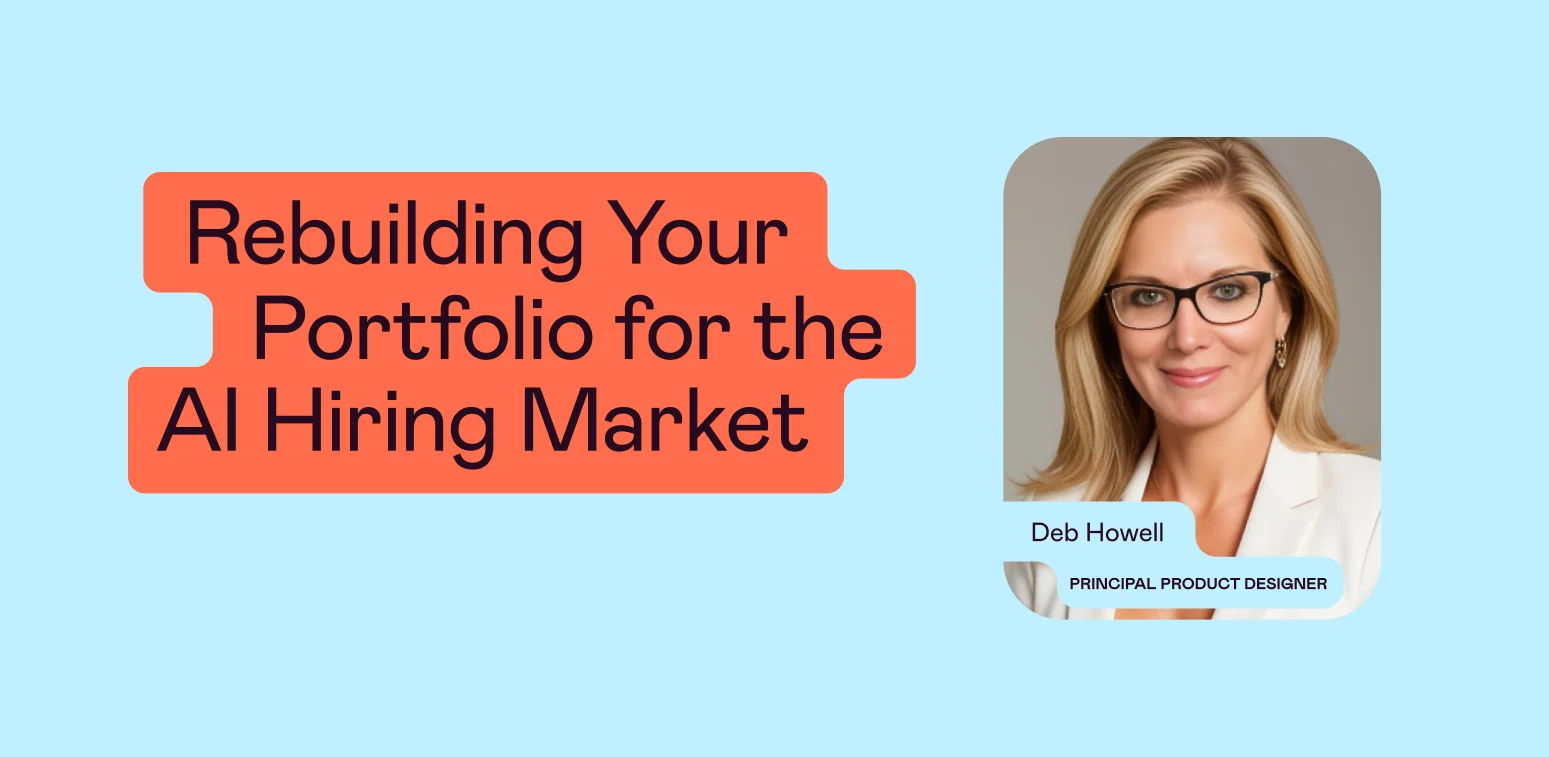
That was the core message of our recent live event, Rebuilding Your Portfolio for the AI Hiring Market, led by longtime Designlab mentor Deb Howell. Using real case studies from Designlab students, Deb walked through a practical framework for revisiting past work, spotting strategic AI entry points, and telling that story to hiring managers, including when to leave AI out entirely.
Watch the full recording below, then read on for a recap of what was covered.
Meet the speaker
Deb Howell is a principal AI designer at Arbitration Forums, where she leads the team building a new model to automate insurance workflows. Based in Austin, Texas, she has 15+ years of design experience and has mentored Designlab students across multiple programs for several years, often staying in touch as they launch their careers. She has also taught in Designlab's AI curriculum.
Five ways in, and one way out
Deb opened with a story. Over the past six months of portfolio mentoring, she noticed that when students strategically added AI to existing case studies, they started getting more interest from employers. The good news for career switchers: nobody expects deep AI expertise. "We're all starting over and learning new," she said, herself included.
Her framework rests on one idea: the skill isn't adding AI, it's knowing which entry point a case study is asking for. She outlined five ways in:
- Sharper questions. Go back to your research and dig deeper with AI's help.
- Rerun the interviews. Feed raw notes and interview transcripts back through AI to surface patterns or "hidden gems" you missed. Deb did this on a project with Google and cut two weeks of synthesis down to a couple of days. Always verify against the source, since AI can hallucinate.
- Reframe the problem. Is the problem you solved still relevant? Could AI change what's possible?
- Prototype a new idea. Use tools like Figma Make or Claude to add exploratory concepts or new competitor research.
- Finish the flow. Build the third user flow you cut to keep your MVP in scope.
And the one way out: leave it alone. Just as product teams shouldn't bolt AI onto a SaaS product, you shouldn't force it into a case study. Users notice, and so do hiring managers. Saying where AI doesn't belong proves you can tell the difference.
Importantly, you don't redo the original work. Keep the case study you're proud of and add a clearly labeled "revisited" section that explains what you learned, where you applied AI, and what changed.
Seven questions to find the seam
To find the right entry point, Deb uses a set of questions to locate the "seam": the spot in a product where a user is doing something by hand, repeating themselves, or guessing. Questions like: Is there a seam? If not, leave it alone. If so, target one step, not the whole product. Has the problem shifted since you first solved it? Does the product already hold the data AI would need?
Whatever you find when answering the questions, it belongs in your storytelling, including what didn't work and why. Every case study should also get one line about where AI should stay out.
Real-time case study evaluations
Deb looked at two case studies from live attendees, and suggested revisions to strengthen them. She closed the session with an audience Q&A.
Attendees received Deb's take-home AI portfolio audit, a worksheet for walking an old project through these questions.
Want to go deeper? Deb mentors in Designlab's Designing AI Products course, a program that stands alone or can be taken as part of the AI Product Design Certification.
Check out additional design talks and workshops on our Events page.