

Great design doesn't always speak for itself. To get your work prioritized, you need to frame it the way your stakeholders think: what problem it solves, what it costs the business today, and what decision you need from them.
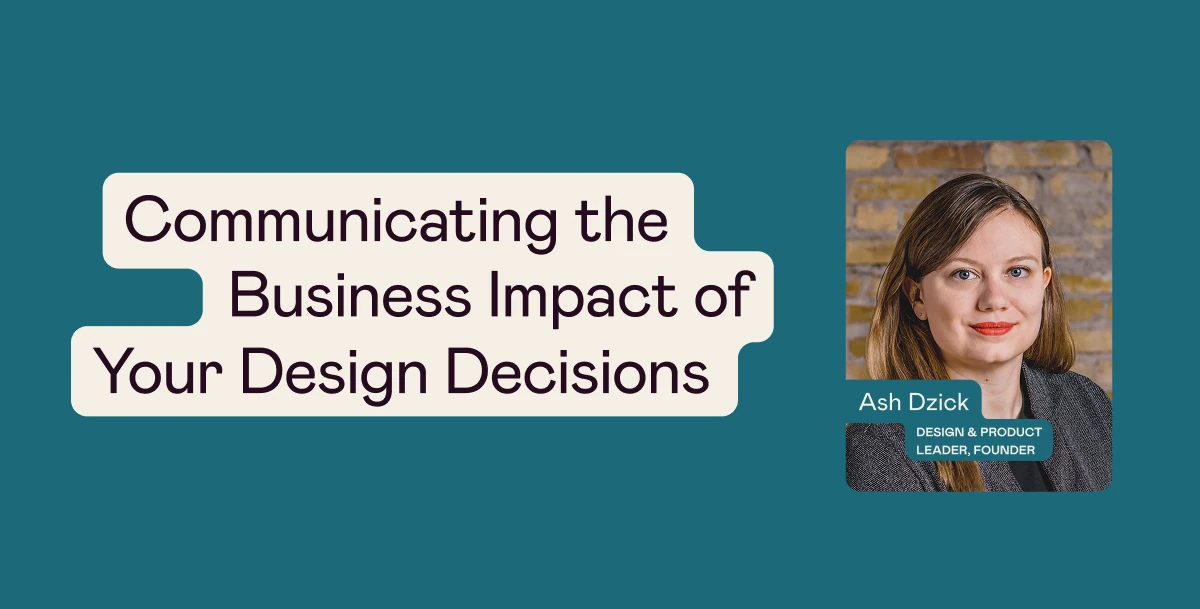
That was the core message of our live event, Communicating the Business Impact of Your Design Decisions, led by design and product leader Ash Dzick. Ash shared a simple framework for turning findings into decisions, and how to show impact even without hard data.
Watch the full recording below, then read on for a recap of what was covered.
Meet the speaker
Ash Dzick is a design and product leader and founder of Top Set, an independent product and design strategy practice. She has led design teams at agencies and enterprises since 2015, has designed for AI since 2018, and chairs the UX Industrial Advisory Board at Milwaukee School of Engineering, where she has mentored design students since 2017.
Why business language matters now
Ash opened with a reminder: "Businesses don't exist on empathy." To get their work prioritized, designers need to speak the language of the business, and that expectation now starts at the junior level. Her tip: treat your stakeholder like another persona. Find out which numbers your PM checks every week, and frame your work around them.
Frame, find, ask
Early in her career, Ash brought her boss a 39-page research report. His response: "I don't care. Get to the point." That lesson shaped her three-step framework:
- Frame the problem. Say what the problem costs the business before sharing findings. "Users are frustrated with checkout" becomes "We lose one in five orders at checkout."
- Find the evidence that matters. Lead with the finding that changes the decision, then list the rest.
- Ask for a decision. Instead of "What do you think?", recommend a change and agree on when you'll check the results.
Showing impact without hard data
Make claims stakeholders can check, not big promises: "Three of five testers finished checkout," not "increased conversion by 40%." Without analytics, capture a before state, like steps or time on task, before you ship changes. That's how Ash showed a redesign cut invoicing from 13 minutes to 7. With no users yet, borrow evidence from industry benchmarks or competitors' one-star app reviews. For portfolio concepts, frame a testable hypothesis and explain how you'd test it with real data.
Ash closed with three habits:
- Write down what you'll measure before a project starts
- Ask "What does this cost us today?"
- Stop leading with your method
Find more design talks and workshops on our Events page.