
.webp)


AI products aren't designed like traditional software — they require a fundamentally different UX approach. In this four-week course, you'll learn the patterns and frameworks behind great AI products — and leave with portfolio-worthy work that proves it.

Course Summary
%20(1).webp)

Have questions about the course?
About this Course
AI is showing up everywhere in product design — sometimes as a whole new product, sometimes as a single feature inside a familiar one. Either way, designing it well requires a playbook most of us were never trained for. Probabilistic outputs, agentic behavior, memory, evaluation, regulatory pressure — these aren't edge cases anymore, they're the core of what good design has to address.
Designing AI Products was created to give you that playbook. Rather than a survey of AI trends or a tour of trending tools, this course teaches you the patterns, frameworks, and craft behind great AI products — drawn directly from how leading teams at Anthropic, Microsoft, Google, and Apple are designing today. You'll learn the design vocabulary, the agentic UX patterns, the content and prompt craft, the trust pillars, and the oversight models that define this new discipline.
Over four weeks, you'll move from foundational mental models to advanced agentic systems — auditing real products, applying patterns to your own work, and building toward a portfolio-ready capstone. You'll leave with the confidence to lead AI product design conversations on your team, the frameworks to make defensible design decisions in a probabilistic world, and a piece of work that proves you can ship in this new era.
Hybrid Course Structure to Maximize Learning
Weekly Video Lectures
Each week course instructor Chris Risdon will explain core concepts via video lecture. Join live or watch asynchronously.

Peer Group Sessions
Later each week you’ll meet in live, mentor-led peer group sessions to share insights and receive feedback on project work.


HaNds-on project work
After watching the lecture you’ll have the opportunity to apply the patterns and frameworks you learn to project work and exercises.

Capstone Project
Your regular project work will build towards a portfolio worthy capstone project.


THE DESIGNLAB HAPPINESS PROMISE
If you’re not a fan of the course and you’ve fully participated, get your money back within 7 days of finishing.
Read more here.
Who It’s For

Made For Designers Building The Next Generation Of Products
AI is reshaping what products are — and the designers who learn to shape it back will define the next decade of work. Designing AI Products is for professionals who want to lead that work, not watch it happen.
🧑🎨 Mid-Career UX & Product Designers Designers with 3–7 years of experience who are being asked (or expect to be asked) to design AI-powered products and features, and want a real framework for doing it well.
👥 Design Team Leads Leaders transitioning their teams toward AI product work who need a shared vocabulary, pattern library, and decision-making toolkit to guide the shift.
💼 Product Managers On AI Features PMs working on AI-powered products who want to collaborate more fluently with designers, engineers, and applied AI — and make sharper calls on what to build.This course is also a strong fit for front-end developers collaborating on AI interfaces who want to understand the design rationale behind the patterns they're implementing.
Please note: This is NOT an introductory UX course — students should have a solid working knowledge of UX fundamentals and design tools like Figma, but no AI or ML technical background is required.
Have more questions about this course? Contact our admissions team.
Design Products People Can Trust
YOU WILL LEARN
Course Curriculum
THE AI DESIGN PARADIGM SHIFT
Understand how AI changes design thinking — from controlling interfaces to orchestrating agents. Learn the difference between deterministic and probabilistic systems, the Passive → Active → Collaborative → Agentic mode spectrum, and the new research methods AI demands.
AI DESIGN PATTERNS, CONTENT & PROMPTS
Build a working library of AI patterns — from invocation to output — including the six core agentic patterns. Learn the craft of designing what AI says and how it's instructed, and treat system prompts as a design artifact alongside content designers and applied AI partners.
TRUSTWORTHINESS, EVALUATION & ONBOARDING
Earn and maintain user trust through the five pillars of AI trustworthiness, plan evaluation strategies for probabilistic systems, and design onboarding that builds user confidence over time. Navigate accessibility considerations and EU AI Act requirements relevant to UX design.
HUMAN CONTROL, AGENTIC SYSTEMS & CAPSTONE
Design effective human oversight for autonomous AI agents and map products onto the full autonomy spectrum, from Basic Assistant to Agentic Ecosystem. Apply Anthropic's composable agent patterns, design delegation interfaces, and present your capstone project.
In Partnership With

Chris Risdon
With roots in the practice going back to 1997, Chris Risdon has designed digital and physical services across interaction, service, and behavioral design. The past five years have brought a deep focus on strategy and design for AI in products and services—at IBM Watson, AI healthcare startup Viz.ai, and eBay, where he is their first designer dedicated fully to AI experiences.
He is co-author of Orchestrating Experiences (Rosenfeld Media), a foundational text on service design, product strategy, and cross-channel systems. Chris has taught graduate Interaction Design at California College of the Arts and Austin Center for Design, and led dozens of workshops and talks at venues including SxSW, UX Lisbon, UX Week, and UX Tokyo on prototyping, behavioral design, and service design.
Showcase Your Work
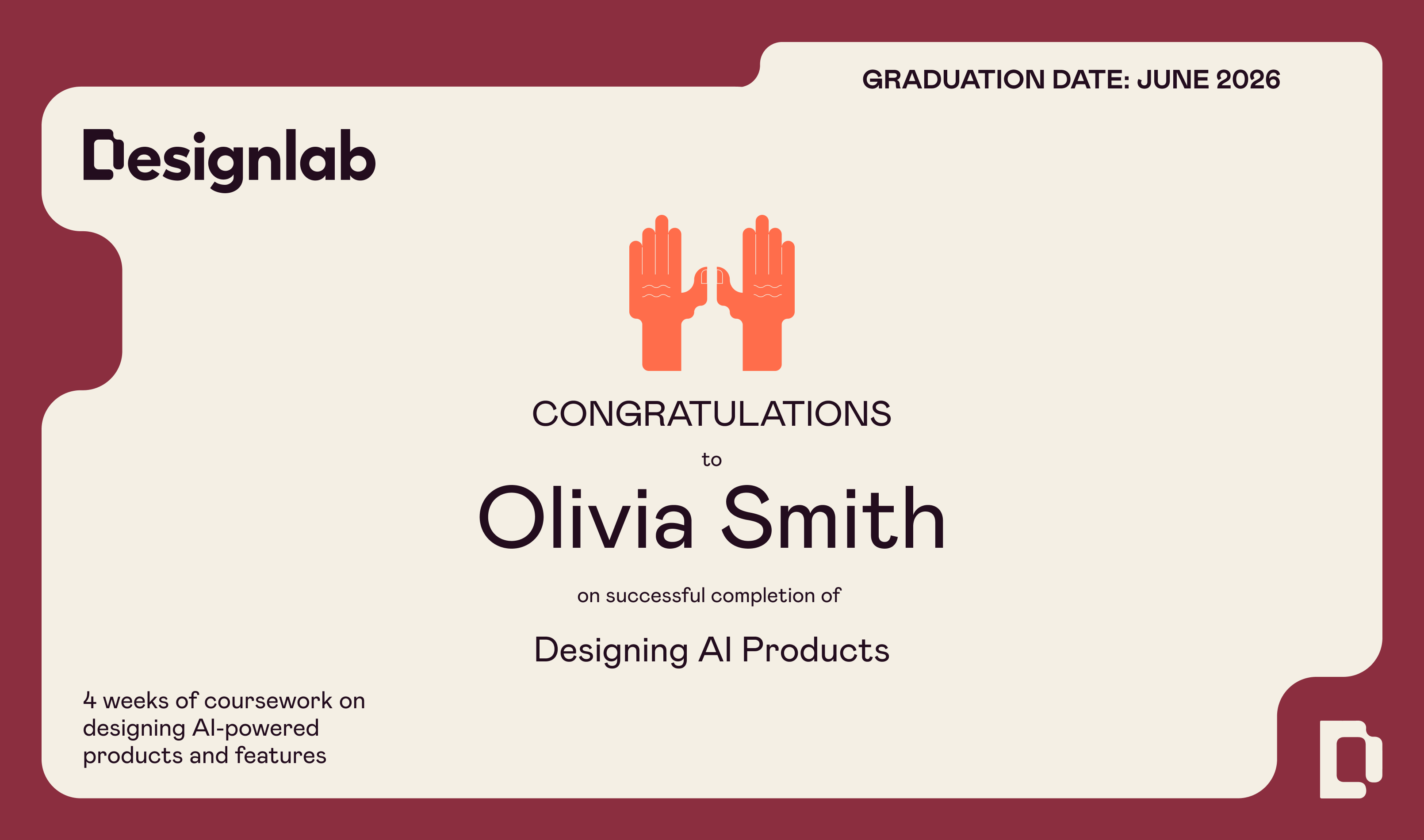
Earn a certificate of completion when you complete our Designing AI Products course, and display it proudly on LinkedIn.
.avif)
Have questions about the course?
Our Students, Alumni, and Mentors Work at Top Companies Around the World










Frequently Asked Questions
Designing AI Products is intended for experienced UX, product, and design professionals with at least 3 years of experience. Students will be expected to understand the full UX design process and have working familiarity with standard design tools like Figma. The course will teach you how to design AI-powered products and features — covering AI design patterns, content craft, trust frameworks, agentic systems, and human oversight. No prior AI design experience or technical AI/ML background is required, but you should be comfortable with core UX fundamentals before enrolling.
If you’re just starting out in UX or product design, we suggest taking UX Academy Foundations, a 4-8 week course that teaches the fundamentals to visual and user interface design.
Designing AI Products is not a tool tutorial — it's a course about designing the products themselves. Throughout the course, you'll examine and learn from leading AI products and frameworks, including:
- Anthropic's Claude and the Building Effective Agents framework
- Microsoft Copilot and the HAX Toolkit
- Google Gemini and PAIR design patterns
- Apple Intelligence
- Claude Code, Replit Agent, and other emerging agentic products
You'll work with these as case studies and reference points — not as tools you're being trained to use.
(If you're looking to learn AI tools for your design workflow, see AI for UX Design; for prototyping with AI tools, see AI Prototyping Camp.)
These courses are designed to complement each other and target different goals.
AI for UX Design teaches you how to use AI in your UX workflow — speeding up research, ideation, prototyping, and testing with tools like Claude, Perplexity, Midjourney, and Stitch. It's about becoming a more efficient designer.
Designing AI Products teaches you how to design AI-powered products and features — the patterns, content craft, trust frameworks, and oversight models behind great AI experiences. It's about designing the kind of products users interact with, not the tools you use to design them.
Many designers benefit from both — using AI to design better, and knowing how to design AI products well. They can be taken in any order or as a bundle.
Yes — Week 4 of the course is dedicated to agentic systems, multi-agent coordination, and human oversight. You'll learn how to map products onto the autonomy spectrum (from Basic Assistant to Agentic Ecosystem), apply established agent patterns like augmented LLMs and orchestrator-workers, and design delegation interfaces that let users set goals rather than specify steps. Agentic concepts are also woven throughout the earlier weeks via the six core agentic UX patterns: Intent Preview, Autonomy Dial, Explainable Rationale, Confidence Signal, Action Audit & Undo, and Escalation Pathway.
Week 3 covers EU AI Act requirements that are relevant to designers — including transparency obligations, human oversight interface requirements, risk classification, and documentation expectations. While this isn't a legal compliance course, you'll leave understanding what the regulation requires of designers, how to classify the products you work on, and how to design for the transparency and oversight requirements that take full effect in August 2026.
You'll complete a portfolio-ready capstone project: a comprehensive AI feature or product design with full documentation. The capstone spans all four weeks with weekly checkpoints, and you can choose to design (a) a new AI feature for an existing product, (b) a redesign of an existing AI feature, or (c) a more ambitious concept product. Your final deliverable includes a design artifact (Figma prototype, wireframe deck, or specification document), written documentation across pattern application, content/prompt approach, trustworthiness, evaluation, regulatory consideration, and oversight, plus a 10-minute presentation.
While the course is built primarily for mid-career UX and product designers, it's also a strong fit for product managers working on AI features and front-end developers collaborating on AI interfaces. Both groups benefit from understanding the design vocabulary, patterns, and frameworks behind AI products — and learning to collaborate more fluently with their design counterparts. The course content is design-centric, but the frameworks apply broadly.
The course is built around durable concepts — design patterns, mental models, trust frameworks, and oversight principles — that hold up regardless of which models or tools dominate at a given moment. Specific examples and case studies are reviewed before each cohort to reflect the current state of AI products. While the AI landscape moves quickly, the design questions ("how do users delegate to agents," "how do we earn user trust," "how do we design for failure") are stable and only growing more relevant.
Yes. Students who successfully complete the Designing AI Products course will receive a Certificate of Completion.
On Mondays at 2pm ET we will host a 90-minute live video lecture with the course creator on Livestorm. During this session you’ll be introduced to core concepts and see live demonstrations.
You’ll have the option of attending this session live or watching the video recording. Before attending your peer group session you should plan to watch this session and complete all the asynchronous lessons and exercises in the platform.
When you enroll in the course you will automatically be enrolled in this session on Livestorm.
Unique to the advanced courses Designlab offers, Peer Group Sessions are regularly scheduled meetings where you connect with other students in the course to discuss the course work. These are facilitated by a professional product designer who has expert-level experience in the topic of the course. The Peer Group Sessions for this course will be held weekly for 60 minutes each.
After you enroll in Designing AI Products, you’ll be emailed a link to confirm the course details and select your peer group time. Typically, peer groups are held several days throughout the week at 12pm ET (9am PT) and 6pm ET (3pm PT).
You’ll meet with your peer group on the same day and at the same time each week of the course.
If you're interested in bundling this course with other advanced courses, you can save $200 for 2 courses, $375 for 3 courses, or $600 for 4 courses. To get started selecting your course bundle, go here.
We also offer a payment plan that allows you to pay half up front and half at the end of the course. To learn more, contact our admissions team.
Students should expect to spend ~6 hours per week on coursework including time for the live lectures, self-paced lessons, practice projects, and peer group sessions. The following milestones will exist each week:
- Monday: New content is released and students have the option of attending the live video lecture or watching a recording which will be sent via email and uploaded to the platform.
- Wednesday, Thursday or Friday: Participants will meet with their mentor and peer group
- 48 hours after meeting with your peer group, you should submit your project work on the platform
- 48 hours after submitting your project work, you’ll receive feedback on your work from your mentor.
You can also unlock the next unit early by completing all lessons and project work ahead of the end-of-week deadline.
You’ll have some flexibility on when you complete coursework, but you should plan to have watched the recording of the video lecture, completed asynchronous lessons and completed exercises before meeting with your peer group.
Absolutely! Many of our students’ tuition is sponsored by their employer. If you have any questions about how to do this when you’re enrolling for the course, please reach out via email to advanced.admissions@designlab.com or set up a call with our admissions team.
Also, to help you with requesting reimbursement, feel free to copy / paste / edit the below email text:
Hi {Manager Name},
I'm writing to you about a course called Designing AI Products that I'd love to enroll in using my learning & development budget. The course is on Designlab, a platform that's trained thousands of UX, UI, and Product Designers who work at companies like Netflix, Amazon, and Google.
The course will cover:
- Designing AI-powered products and features using established design patterns, content principles, and trust frameworks drawn from leading teams at Anthropic, Microsoft, Google, and Apple.
- Applying the six core agentic UX patterns — including Intent Preview, Autonomy Dial, Explainable Rationale, Confidence Signal, Action Audit & Undo, and Escalation Pathway — to design AI experiences users can understand and trust.
- Building for the five pillars of AI trustworthiness — explainability, fairness, robustness, privacy, and transparency — alongside evaluation strategies for probabilistic systems.
- Navigating EU AI Act requirements that take full effect in August 2026, including transparency obligations, human oversight interface requirements, and risk classification relevant to UX design.
- Designing agentic and multi-agent systems with appropriate human oversight, mapping products onto the autonomy spectrum from Basic Assistant to Agentic Ecosystem.
The course is created in partnership with Chris Risdon, co-author of Orchestrating Experiences (Rosenfeld Media) and a designer with two decades of experience building AI products at IBM Watson, Capital One, eBay, and Adaptive Path.
The course format was specifically set up with working designers in mind and includes video lectures, asynchronous lessons, hands-on project work, weekly peer group sessions, and a portfolio-ready capstone project — all facilitated by an expert in AI product design.
The course costs $799 USD, and you can check out the course details [here].
Thanks,
{Your Name}
We’re happy to work with a team or company. Feel free to enroll everyone here or book a call with our team for information on multi-seat discounts, custom trainings, and more.
Designing AI Products is backed by The Designlab Happiness Promise. After you've fully participated in the course, if you're not satisfied, you can get your money back. Read more here.
Design a new kind of product
Enroll in Designing AI Products today to save your seat, or speak with our Admissions team to get answers to any questions.


