

AI agents have quickly gone from a fairly technical concept to something professionals across industries are starting to encounter in their everyday work. From automating administrative tasks to managing complex workflows and supporting business decisions, these tools are changing how people approach work.
But “learning AI agents” can mean very different things. Some people want to understand how agents work and where they might be useful. Others want to build automations, experiment with new tools, or lead AI initiatives within their organizations. And increasingly, you don't need a software engineering background to get started.
For this guide, we focused on AI agent courses and training programs accessible to nontechnical professionals. Whether you're a marketer looking to automate repetitive tasks, a business leader evaluating AI opportunities, or someone simply curious about what agents can do, these programs offer different ways to build practical knowledge and skills.
We put together eight of the best AI agent courses and training programs available in 2026, from short beginner-friendly introductions to more intensive, hands-on learning experiences.
Read more: What is an AI agent?
The Best AI Agent Courses in 2026
- Agentic AI and AI Agents for Leaders by Vanderbilt University
- n8n: AI Agents & Automation for Absolute Beginners by Udemy
- Work Smarter with AI Agents by LinkedIn Learning
- Prototyping Agentic UX by Bentley University
- No Code AI Agents by LearnQuest
- Agentic AI Fluency by Udacity
- Hands-on Agentic AI for Leaders by Maven
- Building and Deploying GenAI Agents for Process Automation by SkillUp
These courses aren't ranked from best to worst. The right option depends much more on your role and goals than on which course offers the most material.
1. Agentic AI and AI Agents for Leaders by Vanderbilt University
.webp)
Best for: Business leaders, managers, strategists, and professionals who want to understand AI agents and their applications.
Format: Self-paced
Duration: Approximately 4 weeks
Technical level: Beginner
Cost: Varies by subscription
Agentic AI and AI Agents for Leaders Specialization, created by Dr. Jules White, is one of the more accessible starting points for people who want to understand agents without becoming AI engineers.
The three-course specialization covers how AI agents work, where they can be useful, automation, human oversight, and basic agent building with tools like custom GPTs. It's estimated to take around four weeks to complete the full specialization at three hours per week.
The appeal is that the specialization combines accessible explanations with practical exercises, giving learners a foundation for evaluating AI opportunities and experimenting with agents without first learning to program.
Consider this course if: You keep hearing about AI agents at work and want to understand what they actually are, where they might be useful, and what it means to work with them.
2. n8n: AI Agents & Automation for Absolute Beginners by Udemy
Best for: Entrepreneurs, freelancers, business professionals, and beginners interested in no-code automation.
Format: Self-paced
Duration: Approximately 4.5 hours
Technical level: Beginner
Cost: Varies based on subscription type
If your goal is less to understand the architecture of an agent and more to make one do something useful, Udemy’s offering is a much lower-friction place to start.
The course teaches learners to build AI agents and automations using tools including n8n, Zapier, ChatGPT, and Gemini—without requiring programming experience. Projects include email assistants, document workflows, transcription and summarization, RAG, and multi-step automations.
These skills can be applied across a wide range of jobs, from automating customer communications and organizing documents to managing routine administrative work. The transferable skill is learning how to identify repetitive processes and turn them into workflows that require less manual intervention.
Consider this course if: You want a practical introduction to building AI agents that you can apply to everyday workflows.
3. Work Smarter with AI Agents by LinkedIn Learning
Best for: Professionals who want to use AI agents in their everyday work
Format: Self-paced
Duration: Approximately 4 hours
Technical level: Beginner
Cost: Varies by subscription
LinkedIn Learning’s Work Smarter with AI Agents learning path takes a practical, workplace-focused approach to agentic AI. Rather than teaching learners how to engineer agents, the four-course series focuses on identifying work that can be delegated, creating useful AI-powered workflows, and learning how to manage and improve the results agents produce.
That makes it a useful option for professionals across industries who are less interested in the technical architecture behind AI agents and more interested in putting them to work. The emphasis is on recognizing opportunities for delegation, creating reliable workflows, and learning how to evaluate and improve the results agents produce.
Consider this course if: You want an approachable introduction to incorporating AI agents into the way you already work.
4. Prototyping Agentic UX: Designing with and for AI by Bentley University
.webp)
Best for: UX/UI designers and product designers
Format: Live intensive
Duration: 2 days
Technical level: Beginner to intermediate
Cost: $1,500
This is the most explicitly design-focused course on the list. Bentley's Prototyping Agentic UX looks at what changes when designers are creating experiences around systems that don't just respond to users, but can take actions on their behalf.
The course covers multi-step agent workflows, user trust, behavioral guardrails, non-deterministic systems, rapid prototyping, and peer critique. Students apply the concepts to their own course project.
That's increasingly relevant to UX designers. If an agent can independently perform several tasks, designers need to think about questions like: When should it ask for permission? What does the user need to know about what it's doing? What happens when it gets something wrong?
Consider this course if: You're designing AI-enabled products and want to understand the UX patterns emerging around agents.
5. No Code AI Agents by LearnQuest
Best for: Beginners who want to build their first AI agent without coding
Format: Self-paced
Duration: Approximately 3 hours
Technical level: Beginner
Cost: Varies by subscription
LearnQuest’s No Code AI Agents course is built specifically for beginners who want to move from understanding agents to actually creating one.
Learners start by breaking an everyday workflow into triggers, decisions, and actions, then use visual tools like Zapier, Make, Power Automate, Dify, or Vellum to turn it into a working agent. Examples focus on practical tasks like scheduling, reminders, follow-ups, and lightweight team coordination.
It’s particularly useful for learning the logic behind AI automation without tying yourself to a single platform or requiring a technical background.
Consider this course if: You want a short, hands-on way to understand how no-code agents are actually built and used.
6. Agentic AI Fluency by Udacity
Best for: Professionals who want to understand how agents fit into business processes and workflows
Format: Self-paced
Duration: Approximately 6 hours
Technical level: Technical level: Beginner to intermediate; prior generative AI knowledge recommended
Cost: Varies by Udacity plan
Udacity's Agentic AI Fluency course is designed for professionals who want a stronger understanding of agentic AI without learning how to engineer the systems themselves. It assumes some familiarity with generative AI, making it particularly useful for learners who already understand tools like ChatGPT and want to explore what happens when AI systems can plan, use tools, and execute multi-step tasks.
The course covers how agents reason, plan, and use tools, but puts those concepts in the context of real business workflows. Learners also explore how to identify good use cases for agents, evaluate their performance, and collaborate more effectively with technical teams.
That makes it a useful middle ground between a quick AI agent introduction and a more technical building course.
Consider this course if: You want enough fluency to recognize useful agent opportunities and participate confidently in conversations about how they should be implemented.
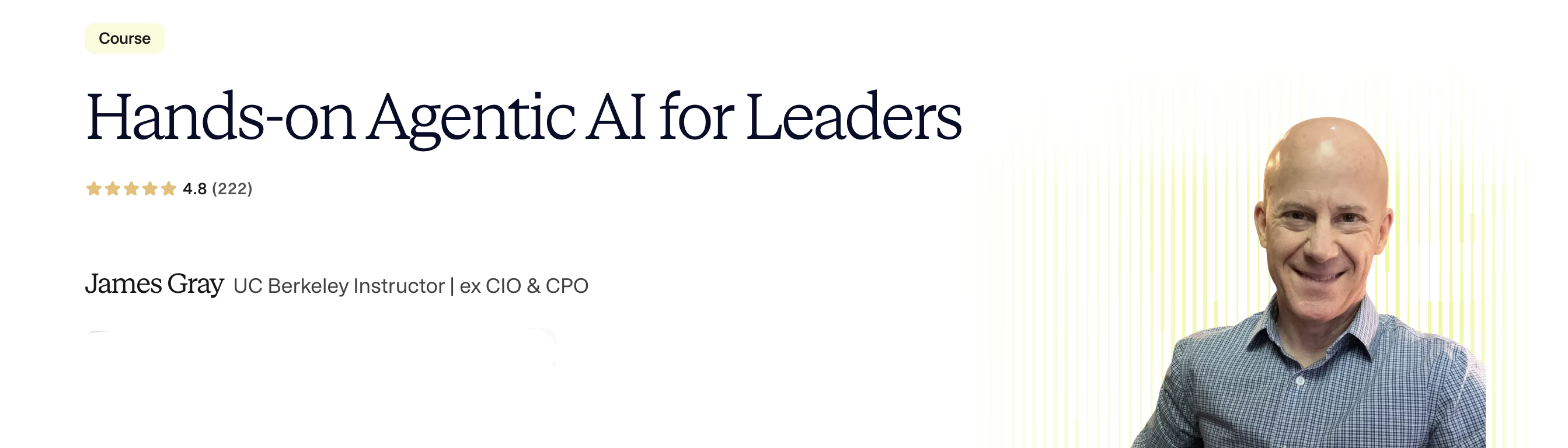
7. Hands-on Agentic AI for Leaders by Maven
Best for: Professionals who want more intensive, live AI agent training
Format: Live cohort
Duration: 4 weeks
Technical level: Beginner to intermediate
Cost: $1,350
For professionals who want more structure and support than a self-paced course can provide, Maven's Hands-on Agentic AI for Leaders takes an applied approach to building AI workflows.
Over four weeks, learners identify recurring work that could benefit from AI, turn those processes into structured workflows, and build increasingly sophisticated systems using tools like ChatGPT, Claude, Gemini, and Microsoft 365. The program also introduces AI code editors and workflow management techniques, making it more involved than a basic no-code introduction.
No coding experience is required, although learners need a paid subscription to at least one supported AI assistant. Live instruction, individual coaching, and feedback provide opportunities to apply the material to their own work.
Consider this course if: You want live guidance and enough time to apply agentic AI to meaningful workflows from your own job.
8. Building and Deploying GenAI Agents for Process Automation by SkillUp
Best for: Business professionals, managers, and operations teams looking to implement AI agents in everyday workflows
Format: Self-paced
Duration: Approximately 10 hours
Technical level: Intermediate; no coding experience required
Cost: Varies by Coursera subscription
While many AI agent courses focus on understanding the technology or building simple automations, SkillUp's Building and Deploying GenAI Agents for Process Automation explores how agents can improve larger business processes.
The four-module course covers identifying automation opportunities, designing multi-step workflows, and building agents using no-code tools like Zapier Agents. Learners also explore deployment, performance monitoring, and measuring business impact, with a final project focused on creating an end-to-end automation workflow.
Designed for nontechnical professionals with some familiarity with generative AI, the course is particularly useful for those looking to move beyond individual productivity tools and apply agents across teams or organizations.
Consider this course if: You want to build and implement AI agents that automate real business processes.
Which AI Agent Course Is Right for You?
With AI agent training, what you want to accomplish matters more than course length or the number of tools covered. Before choosing a program, think about whether you're looking to understand how agents work, build something practical, or bring agentic AI into your organization.
If you're completely new to AI agents, start with a course that explains the fundamentals without requiring technical experience. Vanderbilt's Agentic AI and AI Agents for Leaders offers a broader introduction to the subject, while LinkedIn Learning's Work Smarter with AI Agents focuses on applying these ideas to everyday work.
If you want to build AI agents without coding, look for training centered on accessible automation platforms like n8n, Zapier, and Make. Udemy's n8n course and LearnQuest's No Code AI Agents both introduce practical workflows that can help you automate tasks, connect tools, and experiment with agents on your own.
If you're responsible for evaluating or implementing AI at work, you may benefit from training that goes beyond individual productivity. Udacity's Agentic AI Fluency explores how agents fit into business processes, while Maven's Hands-on Agentic AI for Leaders offers a more intensive approach to building and managing AI workflows.
If you work in product management or UX design, there are also more specialized options. Maven's Agentic AI for Product Managers focuses on prototyping and evaluating agentic systems, while Bentley's Prototyping Agentic UX explores how designers can create experiences around AI agents that act on users' behalf.
The format matters, too. Self-paced courses offer a flexible way to explore the field, while live programs can be worth the investment if you want instructor feedback, structured projects, or guidance applying what you're learning to real-world challenges.
Ultimately, the right course depends on how you want to use AI agents. You don't need to master every tool or concept at once. Start with the skills most relevant to your goals, and build from there.
Final Thoughts
There's no single learning path for AI agents, and for most professionals, getting started doesn't mean becoming an AI engineer.
Some people want to understand where agents can create value. Others want to build no-code workflows, automate repetitive tasks, or develop the knowledge to bring agentic AI into their organizations. The right training depends on what you're hoping to accomplish and how much hands-on experience you want along the way.
The good news is that you don't need to learn everything at once. Start with the skills closest to the work you want to do now, and build toward more advanced training as your needs evolve.
AI tools and platforms will continue to change, but learning to recognize useful applications, evaluate results, and understand how agents work will remain valuable regardless of which tools come next.


.webp)

.webp)