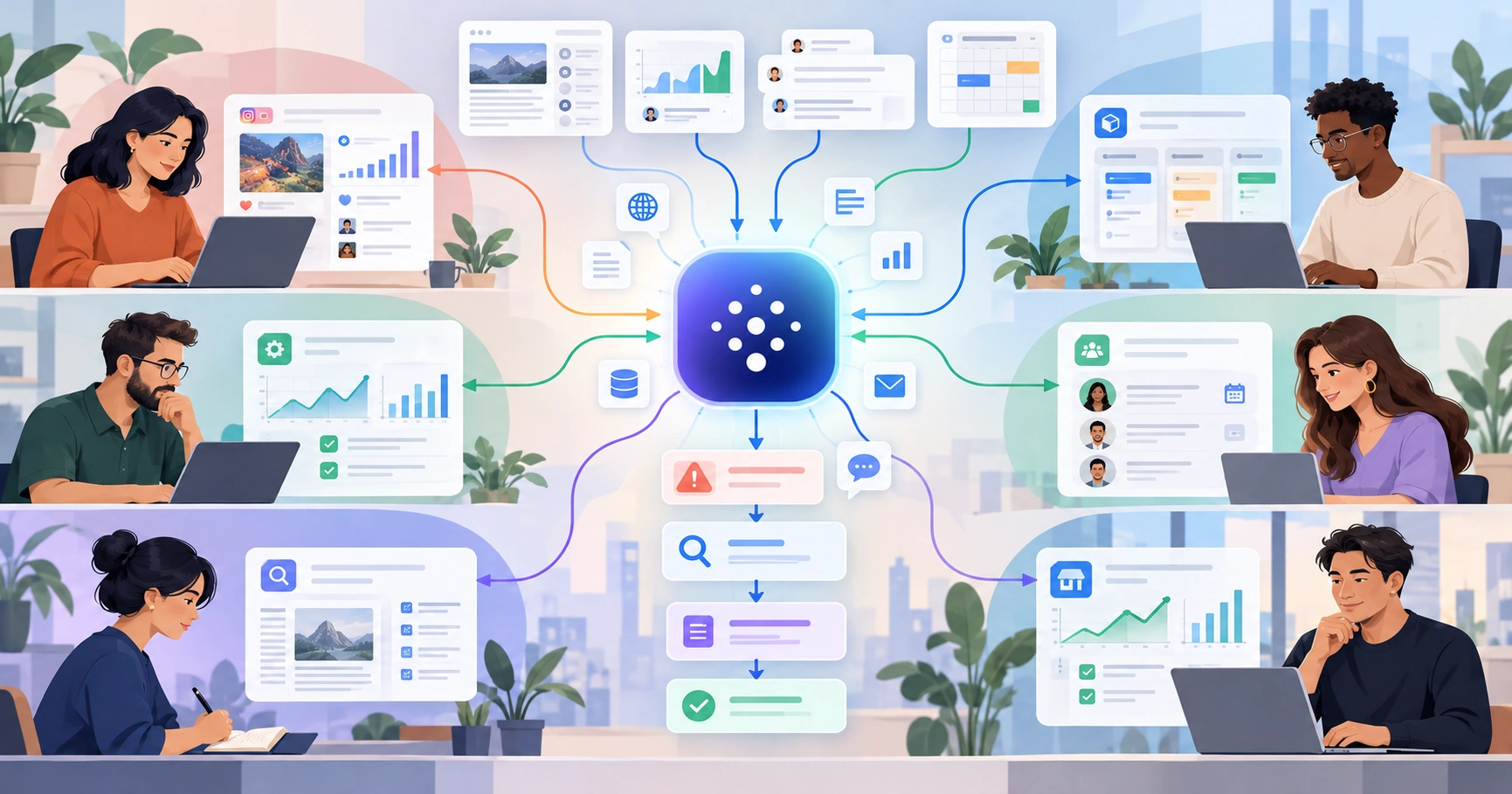


AI agents are quickly becoming one of those terms that seems to mean everything at once. Depending on where you look, they’re answering customer questions, monitoring competitors, researching markets, organizing projects, screening information, and handling work across a growing number of industries.
So what does an AI agent actually look like in practice?
The most useful examples usually aren’t about handing an entire job over to AI. They’re much more specific: keeping an eye on something that changes, sorting through large amounts of information, investigating when something looks unusual, or helping move work forward when the next step isn’t always predictable.
That’s where agents begin to differ from a standard chatbot or a simple automation. You can give an agent a broader goal, and what it does next can change based on what it learns along the way.
For example, instead of asking AI to:
Summarize this document, then write an email.
You might ask an agent to:
Monitor this situation, investigate anything important that changes, and tell me when I need to pay attention.
That flexibility opens up useful possibilities across all kinds of work—from marketing and operations to research, recruiting, consulting, and running a small business.
Below, we’ll look at 20 practical examples of what AI agents can do, why an agent makes sense for each task, and the kinds of work where this approach can actually be useful.
AI agent examples for marketing
Marketing teams spend a surprising amount of time monitoring, comparing, analyzing, and deciding what deserves attention. Those are all areas where an agent can potentially help—not by making every marketing decision, but by doing more of the investigative work that happens before one.
1. Competitor monitoring agent
Goal: Make sure the team knows when competitors make strategically meaningful changes.
A competitor-monitoring agent could keep an eye on selected websites, product announcements, pricing pages, and other relevant sources. Rather than alerting the team every time a competitor changes a headline, it could compare new information with what was there before and decide whether the change warrants further investigation.
A small copy edit might lead to no action at all. A new enterprise offering, on the other hand, could prompt the agent to inspect pricing, product pages, press releases, and related messaging before preparing a short briefing for the team.
The useful part isn’t simply the monitoring. It’s the ability to distinguish between routine changes and developments that may actually matter.
2. Campaign-performance investigation agent
Goal: Identify unusual campaign performance and investigate likely causes.
Most reporting tools can tell you that a number went up or down. An agent could help with the next question: Why?
If conversions suddenly decline, for example, the agent might compare performance across channels, discover that the change is concentrated in paid social, narrow the issue to a particular campaign or creative, and check whether the timing lines up with a recent change.
If everything remains within normal ranges, there may be nothing to report. If something unusual appears, the agent could prepare a briefing with the evidence it found and the areas worth investigating further.
3. Content-opportunity agent
Goal: Identify promising content opportunities for a defined audience.
Instead of asking AI to generate a long list of content ideas, an agent could monitor relevant conversations, questions, search trends, or industry developments and compare them against what your organization has already published.
If it identifies a meaningful gap, it could research the topic further, assess whether it fits your audience and priorities, and prepare a brief. If the opportunity is weak or already well covered, it can move on. That creates a very different workflow from simply asking a chatbot, “What should we write about?”
4. Brand-monitoring agent
Goal: Surface brand mentions that actually require attention.
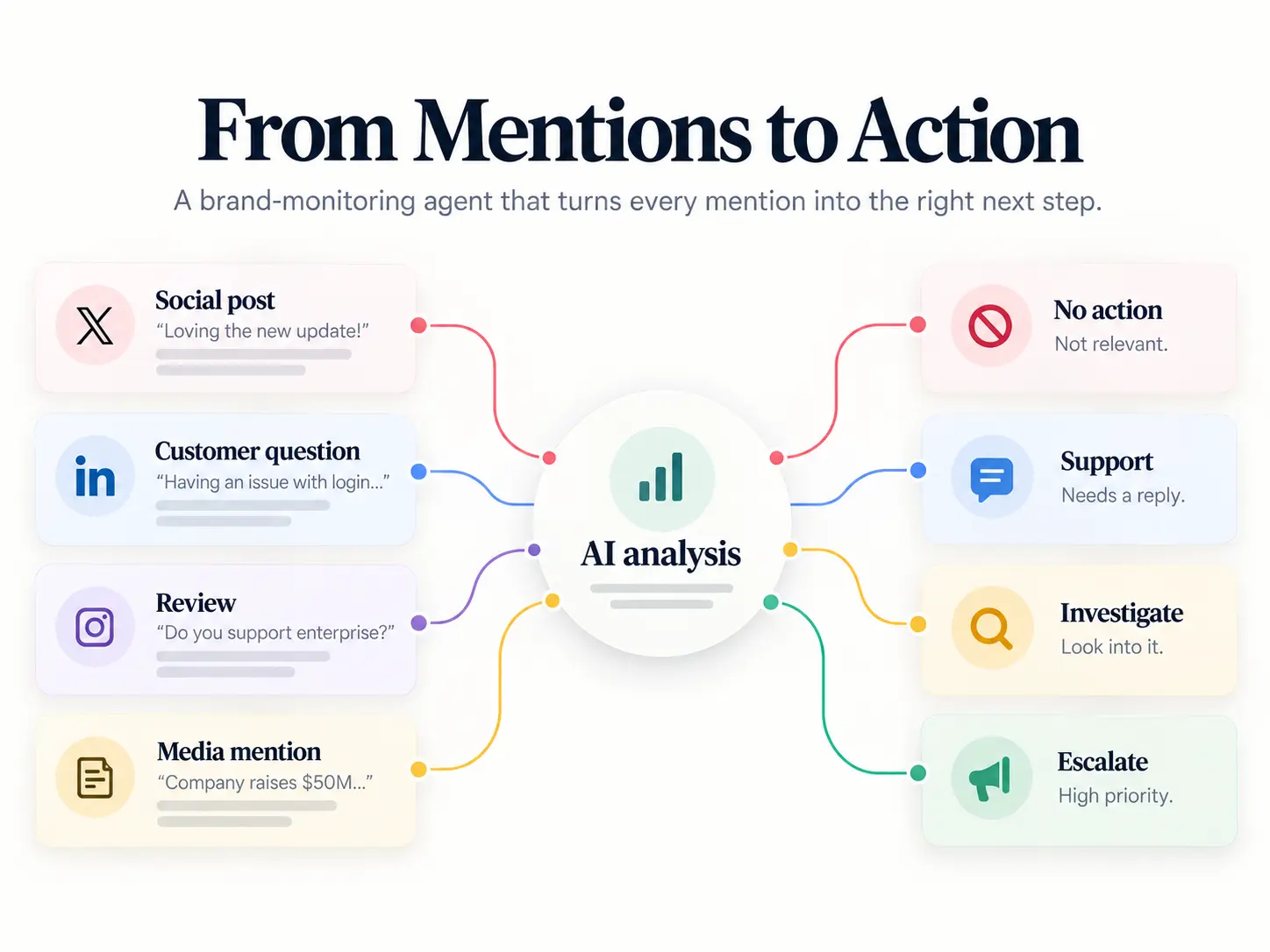
A traditional monitoring tool can collect mentions. An agent could help interpret them.
Routine praise may require no action. A product question could be routed to support. A factual error from a high-reach account might need a communications response. A sudden cluster of complaints could warrant deeper investigation.
The value is in helping the team separate everyday noise from the moments that actually need a response.
AI agent examples for operations
Operations work is often full of recurring processes that are predictable most of the time—but not all of the time. That makes it a useful place to think about combining ordinary automation with agents that step in when something requires interpretation or judgment.
5. Request-intake agent
Goal: Make sure incoming requests reach the right person with enough context to act.
Imagine an organization receives requests through a shared form or inbox. Some are straightforward; others arrive incomplete, fall into multiple categories, or need additional context before anyone can act on them. An agent could interpret each request, check relevant policies, identify missing information, determine the right owner, update the appropriate internal system, and route the request accordingly. If the situation falls outside its normal boundaries, it could escalate it instead.
That flexibility is what makes an agent useful here: it can handle routine requests quickly while adapting when something doesn’t fit the usual pattern.
6. Vendor-review agent
Goal: Help the team identify vendors worth evaluating.
Vendor research often involves gathering the same kinds of information from many different places: capabilities, pricing, security documentation, customer examples, integrations, or contract terms. An agent could collect that information, compare it against a predefined set of requirements, flag anything missing or potentially concerning, and prepare a first-pass comparison for a person to review.
The final decision can remain human while the agent takes on much of the repetitive research required to get there.
7. Weekly operations briefing agent
Goal: Tell leaders what changed this week and what requires attention.
A useful weekly briefing involves more than dumping together a list of status updates. An agent could review project systems, compare current progress with previous commitments, identify overdue work, notice emerging dependencies, and investigate unusual changes before preparing the briefing.
The goal would be to surface the handful of things someone genuinely needs to know—not simply summarize everything that happened.
8. Process-exception agent
Goal: Keep a routine business process moving when something unusual happens.
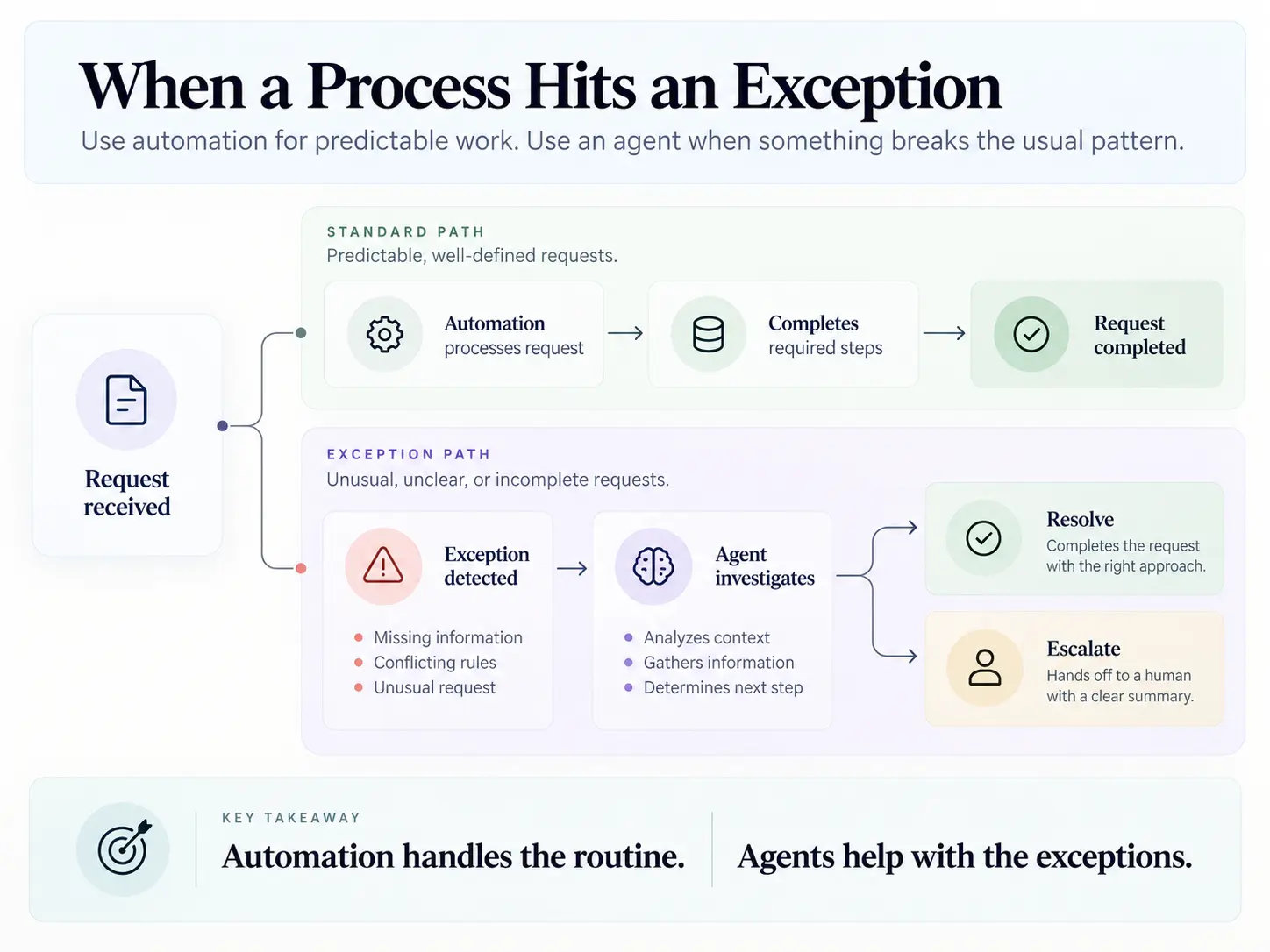
Many business processes don’t need an agent from beginning to end. Ordinary automation may work perfectly well for the majority of cases.
An agent becomes more useful when something breaks the expected pattern: information is missing, two rules conflict, a request doesn’t fit an existing category, or a situation requires a judgment call. In that model, automation handles predictable work and an agent helps with the exceptions. That can be more reliable—and considerably simpler—than trying to make an entire process agentic.
Anthropic recommends starting with the simplest approach that works and only adding complexity when it’s actually useful. For well-defined tasks, predefined workflows can offer more predictability and consistency; agents make more sense when the work genuinely requires flexibility and model-driven decision-making.
AI agent examples for product teams
Product teams already work with large amounts of messy information: customer feedback, support conversations, research, competitor activity, project updates, and internal priorities. Agents can be useful when the goal is to connect those signals without expecting one person to manually monitor everything.
9. Customer-signal agent
Goal: Alert the team to emerging customer problems.
A customer-signal agent could monitor sources such as support tickets, interview notes, reviews, and feedback forms for patterns that deserve attention.
If a particular complaint starts appearing more frequently, the agent could investigate which groups of customers are affected, compare the pattern with previous periods, check whether a recent product change might be related, and prepare a summary with supporting evidence. Rather than treating every individual piece of feedback as equally important, the agent helps identify when many small signals begin to add up to something bigger.
10. Competitive-feature agent
Goal: Track competitive product changes relevant to your organization.
Not every feature a competitor releases matters to you. An agent could monitor relevant competitors and, when something new appears, assess whether it overlaps with one of your current priorities. If it does, the agent could gather additional details, compare the new feature with your own offering, and prepare an alert explaining why it may be relevant.
If it has little connection to what your organization is working on, there may be no reason to interrupt anyone.
11. Project-risk agent
Goal: Identify project risks before they become blockers.
A project-risk agent could review project updates, open questions, deadlines, and dependencies to look for signs that something is beginning to slip. One delayed task may not matter. A delayed task that blocks three others and puts an upcoming milestone at risk is different.
The agent could investigate the surrounding context and flag the issues that appear most likely to need intervention, giving the team a chance to respond earlier.
AI agent examples for consultants and agencies
Consultants and agencies often work across multiple clients, industries, and projects at the same time. Agents can help maintain context between engagements and reduce some of the repetitive information gathering behind client work.
12. Client research agent
Goal: Keep a consultant current on a client’s market between major engagements.
An agent could monitor companies, competitors, regulations, industry news, and other sources that matter to a particular client. Rather than forwarding every update, it could determine which developments are likely to be relevant, investigate their potential implications, and prepare a concise briefing tied to the client’s priorities.
That can make ongoing monitoring more useful without requiring someone to constantly sift through information manually.
13. Proposal-preparation agent
Goal: Prepare a first-pass proposal using existing organizational knowledge.
Preparing a proposal often means finding similar past work, relevant experts, useful case studies, and information from previous client conversations. An agent could gather those materials, identify what information is still missing, and prepare a tailored first draft for human review.
Different opportunities could lead it to surface different projects, examples, or internal expertise depending on what the prospective client actually needs.
14. Client-status agent
Goal: Make sure an account lead knows when a client project needs intervention.
Instead of asking someone to constantly review every project update and conversation, an agent could monitor selected systems for unusual delays, unresolved questions, shifting timelines, or other signs that a client engagement needs attention. When something appears off, it could look into the surrounding context before deciding whether it warrants escalation.
That allows routine work to stay routine while making significant issues harder to miss.
AI agent examples for research
Research is particularly well suited to agentic behavior because new evidence often changes what should be investigated next.
15. Research-investigation agent
Goal: Investigate an open research question.
Suppose you want to understand:
Why are new customers failing during onboarding?
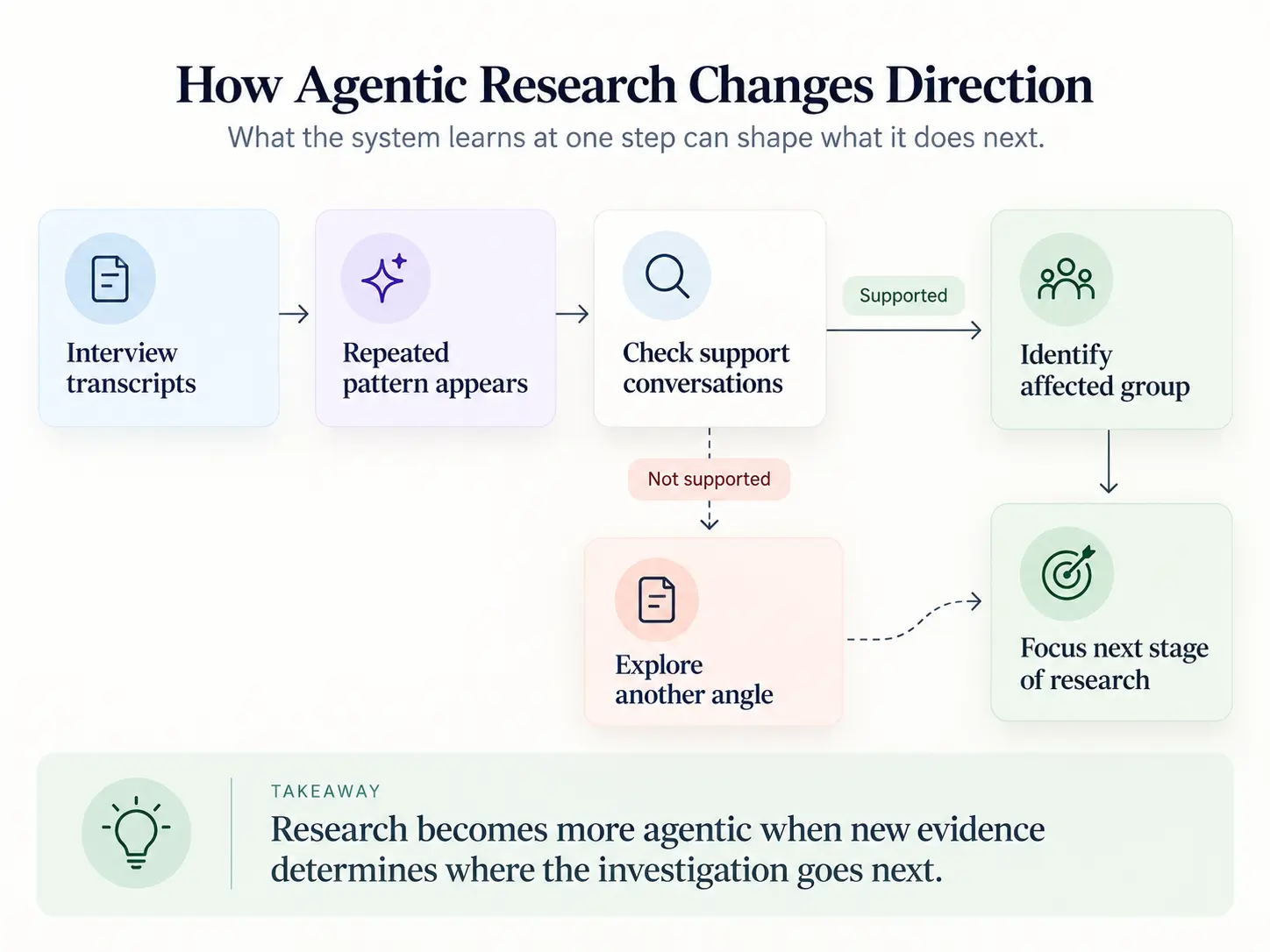
An agent might begin with interview transcripts and notice repeated complaints about one particular setup step. That could lead it to search support conversations for similar evidence, where it discovers that one group of users is disproportionately affected. From there, it might focus the next stage of the investigation on that group.
This is different from simply asking AI to summarize a collection of interviews. The evidence changes the direction of the research.
16. Research-monitoring agent
Goal: Keep the team aware of relevant new research.
An agent could monitor a defined set of publications, organizations, databases, or other sources and determine whether newly published material is actually relevant to a particular topic. If something meaningfully changes the current understanding of the subject, the agent could compare it with existing knowledge and prepare an alert. If it merely repeats what the team already knows, it may not need to surface it at all.
The value is less about collecting more research and more about helping the team notice the research that actually changes what they should pay attention to.
AI agent examples for recruiting and HR
Recruiting and HR involve a great deal of information processing, but they also involve decisions that directly affect people. That makes boundaries especially important: agents may be useful for gathering, organizing, and routing information without handing consequential decisions over to AI.
17. Candidate-intake agent
Goal: Give recruiters useful, consistent information about incoming candidates.
An agent could organize information from applications, compare it against explicit role requirements, highlight relevant experience, identify gaps or questions that may need human attention, and prepare a structured brief.
That can reduce some of the manual processing around applications while leaving hiring decisions where they belong: with people.
18. Employee-request agent
Goal: Resolve routine HR requests and route more complicated situations correctly.
A straightforward policy question might be answered immediately using approved internal information. A more complicated request could require checking multiple policies, gathering additional details, opening a ticket, or escalating the situation to an HR professional.
The agent can adjust its path depending on the nature of the request rather than treating every employee question the same way.
AI agent examples for founders and small teams
For small teams, one of the biggest challenges is often not a lack of information but a lack of time and attention. Agents can be useful when they help prioritize what actually deserves a person’s focus.
19. Founder briefing agent
Goal: Tell a founder or team leader what genuinely needs attention.
An agent could review selected business information—projects, customer activity, sales updates, support trends, or other sources—and look for meaningful changes or anomalies. Rather than producing another long report, it could investigate anything unusual and prepare a short briefing focused on the decisions or developments that matter most.
The value isn’t more information. It’s better prioritization of the information that already exists.
20. Business-opportunity agent
Goal: Identify inbound opportunities worth someone’s time.
A small team may receive partnership requests, sales inquiries, speaking opportunities, media requests, or other inbound messages that vary widely in quality. An agent could research the sender when necessary, determine whether the opportunity aligns with predefined priorities, request missing information, filter out clear mismatches, or prepare a recommendation for someone to review.
The goal isn’t to automatically say yes or no. It’s to reduce the amount of time people spend figuring out which opportunities deserve a closer look.
What actually makes something an AI agent?
Not every workflow that uses AI is an agent. Some of the examples above may also include ordinary automation or AI-generated content, but the more important question is how much responsibility the system has for deciding what happens next.
A traditional automation follows a predefined rule. An AI workflow may use AI within a sequence of steps that has already been mapped out. An agent has more flexibility to pursue an outcome, choose among possible actions, and adjust its approach based on what it learns along the way.
Anthropic makes a similar distinction between workflows, where tools and AI models move through largely predefined paths, and agents, where the model has more freedom to determine its process and tool use.
A useful shorthand is:
- Automation: When this happens, do that.
- AI workflow: Follow these steps, using AI where needed.
- Agent: Here’s the outcome. Decide what to do next based on what you encounter.
The boundaries aren’t always clean, and many real systems combine all three. What matters is that an agent can adapt its path as the situation changes, rather than simply moving through a fixed sequence.
Which AI agent should you build first?
With 20 examples on the table, it can be tempting to start with the most ambitious one. Usually, that isn’t the best place to begin.
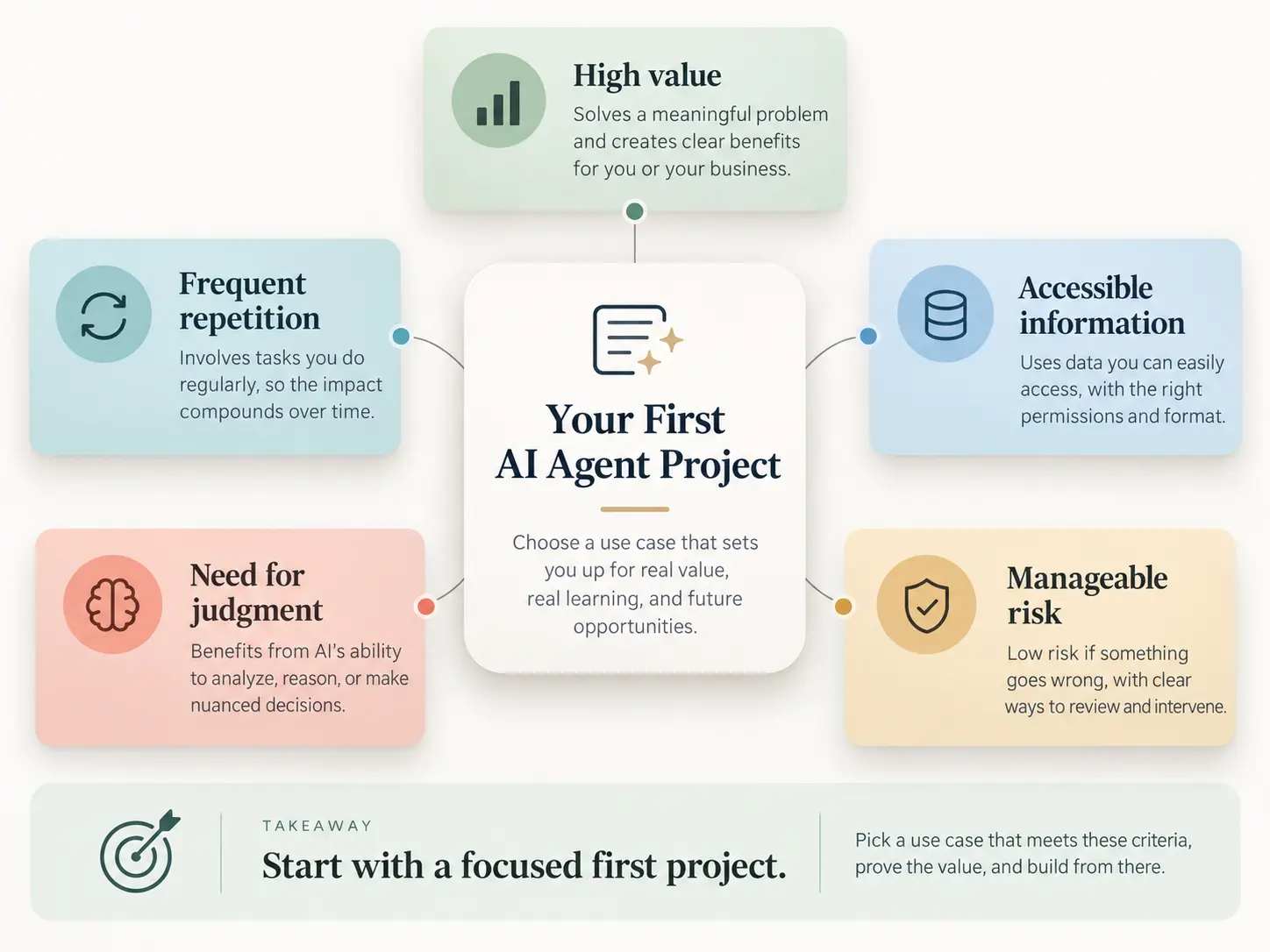
A better first agent combines a few things:
- High value: Solving the problem saves meaningful time, improves an important decision, prevents mistakes, or creates another clear benefit.
- Frequent repetition: The work happens often enough that improving it is worth the effort.
- Accessible information: The agent can actually reach the information it needs.
- A real need for judgment: Simple rules would struggle because different situations require different responses.
- Manageable risk: You can test the workflow safely and keep people involved in consequential decisions.
Google Cloud recommends a similar approach, evaluating potential AI use cases based on factors such as business value, feasibility, data readiness, and risk. Its guidance for agentic systems also emphasizes prioritizing use cases where autonomous decision-making can create a clear, measurable benefit rather than starting with complexity for its own sake.
A narrow workflow that solves one real problem reliably is usually a better first agent project than an ambitious “AI employee” that tries to run an entire function.
Do AI agents have to replace people to be useful?
No. Much of the hype around AI agents focuses on the possibility of replacing entire jobs or teams, but that isn’t necessary for an agent to create meaningful value.
In many cases, the more practical opportunity is much smaller: take one recurring, time-consuming part of a job and make it easier. An agent that saves someone several hours of research each week, helps a team process requests more consistently, gives an organization earlier warning about an emerging problem, or reduces repetitive information gathering can still have a meaningful impact.
That matters because most jobs aren’t made up of one single task. They’re a mix of judgment, communication, coordination, decision-making, and repetitive work. An agent may be especially useful when it can take on some of the lower-value or more routine pieces without removing the need for the person doing the work.
For most people, that may be a more useful way to think about agents today. Rather than asking:
What entire job can this replace?
Instead, ask:
What recurring part of my work could I delegate, and what could I do with the time and attention I get back?
The best AI agent ideas start with your work
The examples above span marketing, operations, product, consulting, research, recruiting, HR, and small-business work, but the goal isn’t to find one and copy it exactly.
Instead, look for the patterns underneath them. Some agents monitor, detect, investigate, and alert. Others receive a request, interpret it, gather information, and route it. A research agent may investigate, discover something unexpected, change direction, and synthesize what it learned. An operations agent may observe a process, identify an exception, investigate it, and either resolve or escalate it.
Those patterns can show up in almost any profession. And that’s one reason AI agents are relevant to such a broad group of people. You don’t need to be a developer—or work in a particular industry—to start identifying places where an agent could be useful.
The tools will continue to change. The more durable skill is learning to look closely at your own work and recognize where a system that can observe, decide, act, and adapt could genuinely make that work better.
Want to gain hands-on experience building AI agentic workflows for your work? Check out this new AI agent course from Workbench, a division of Designlab.


.webp)

.webp)