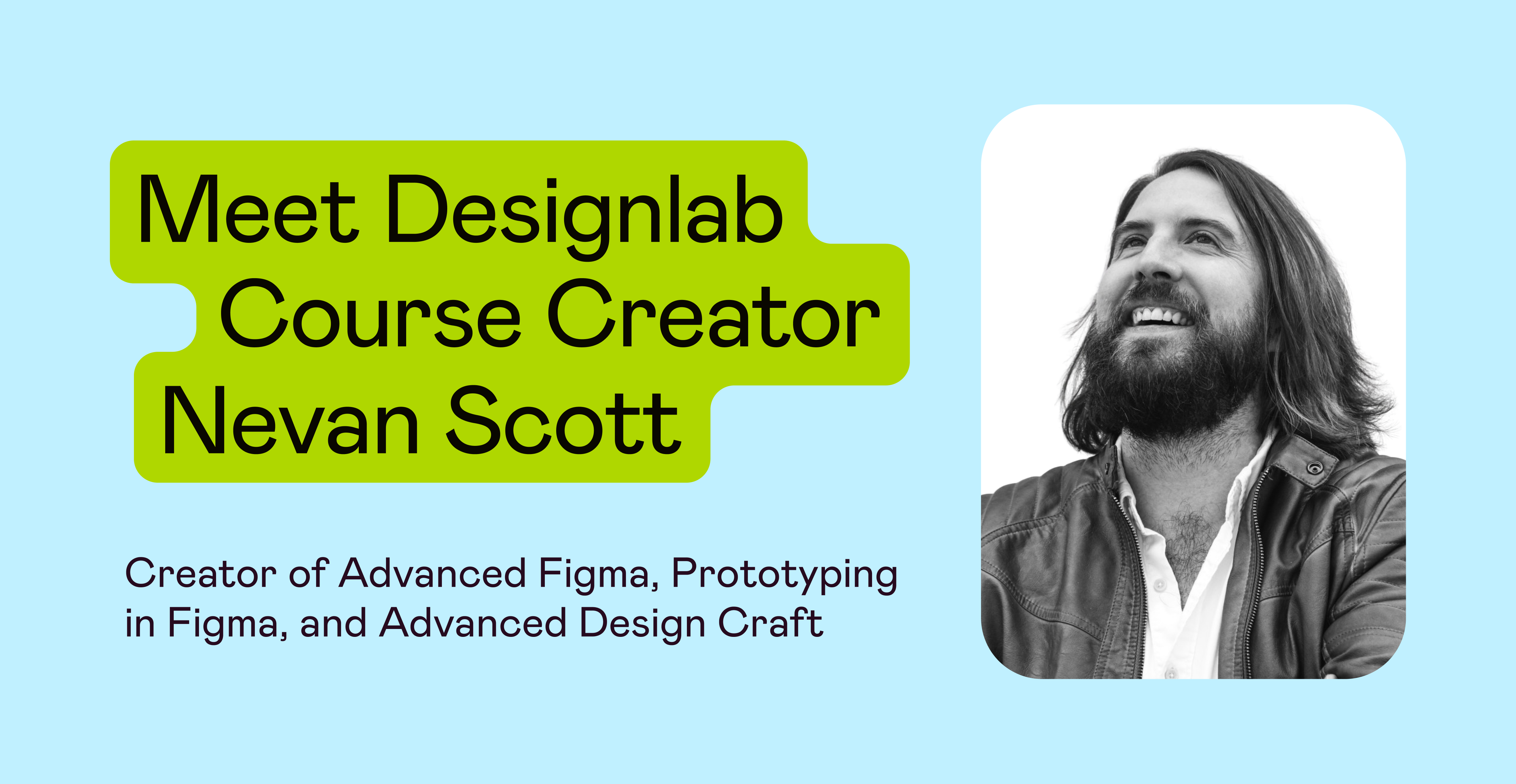


We sat down with Nevan Scott, course creator for Designlab’s Advanced Figma, Prototyping in Figma, and Advanced Design Craft. Nevan grew up alongside the web — a self-taught preteen obsessed with publishing in HTML, then a full-stack designer-developer at a time when those weren't separate jobs. At Designlab, he teaches designers deep craft and tool fluency.
We talked with him about being one of the last generalists, the GUI pioneers who still shape how he thinks about his work, and why the current moment in tech feels, for all its complications, like a second chance for designers.
A Career Built Between Design and Code
Nevan was nine or ten when a friend opened Notepad on a Windows 95 machine, typed a few angle brackets, saved the file with an .html extension, and opened it in a browser.
"To me, that was like seeing someone print a newspaper."
His first published site was a school protest page, built out of frames and image rollovers in the late nineties. He calls it terrible, but the takeaway wasn't the craft. It was the realization that he could put something on the internet at all. "We take that for granted now. At the time, I was like, this is a superpower."
To pay his way through college, Nevan designed and built sites for professors, then took on bigger internal projects, including his school's unique student evaluation system, an alternative to traditional grading systems.
Around 2005, his boss handed him the O'Reilly book on Information Architecture co-authored by Louis Rosenfeld and Peter Morville, now widely considered a foundational text in UX. "I devoured that book. It got me prototyping. It got me thinking in a really user-centered way and developing methodologies around doing it."
What stands out about Nevan's early career is that he was doing usability testing and user research at the same time that he was learning how to build databases.
“What is now considered full stack for a developer or a designer — there was a time when I was both at the same time."
From college he moved to Los Angeles for a year of agency work, then to New York for a string of projects, including a stint at BuzzFeed designing and building the first mobile version of their site. He eventually co-founded his own agency in New York and ran it for several years before stepping into teaching.
It's that depth of thinking — about how design and computing actually fit together — that makes Nevan such an effective course creator and instructor. He co-created Advanced Figma and Prototyping in Figma at Designlab, both built around the conviction that real craft starts with deep tool fluency: not just knowing where the buttons are, but understanding what they're actually doing and why. It's the kind of foundational mastery Nevan had to acquire piecemeal during his generalist years, now taught as a structured curriculum.
Design as Craft
The foundational principle that informs Nevan’s teaching is that designers should know their medium intimately. UI work, he says, isn't a matter of dragging components around a canvas. It's a craft that rewards close attention to detail — pixels, motion, hierarchy, the way every element behaves under a user's hand — the same kind of attention early pioneers brought to the first interfaces ever made.
It's that depth of thinking that makes Nevan such an effective course creator and instructor. He co-created Advanced Figma and Prototyping in Figma at Designlab, both built around the conviction that real craft starts with deep tool fluency.
A pixel-level attention to UI craft is also at the heart of Nevan's most recent course at Designlab, Advanced Design Craft, a certification program for experienced designers to sharpen their visual precision and judgment.
With the rise of AI design and coding tools, the focus of Nevan’s programs haven’t changed, but he points to the past as a way of navigating this new reality. The medium of digital design has always been code, but for the last couple of decades, he says, designers have been increasingly insulated from it.
"That's not a primary competency. But if you go back to the eighties — the development of the first commercially available graphical user interfaces, the early Mac, the Lisa, the early versions of Windows, the stuff coming out of Xerox PARC — the people who defined the entire field we all work in, there was no such thing as a designer who did not write code. It wouldn't have made sense to think of those as separate skills."
He points to two figures who shape how he thinks about the craft. Susan Kare, who designed the original Mac's icons and typography using a sketchbook with a pixel grid, working in pure black and white because the original Mac had no grayscale. And Bill Atkinson, who developed QuickDraw, the algorithm that made it possible to drag a window across the screen and have it feel responsive — and who also designed MacDraw, whose tool palette of paint buckets and icons informed the lineage of design tools that have followed.
"So the reason the current moment makes me think about all of this is that, for a long time now, designers have felt very disconnected from code. Code is an abstraction layer that's not part of how we think about our work."
Designers, in Nevan's perspective, have learned to think about their work in a few different registers — what it looks like, how it feels, how humans understand and use it.
"You cannot be good at all of those things, so it makes sense that there's a lot of specialization. But I've always felt that it was a shame that we got so far away from how computing itself actually happens and works."
The cost of that distance, he thinks, is the work becoming abstract. "When part of your job is to make a blueprint and then hope that everyone does a good job implementing your blueprint, your work is very abstract. The way to be more concrete in your work is to actually get a little bit into the weeds of: okay, but how does this thing actually work?"
If you go back to the eighties...there was no such thing as a designer who did not write code. It wouldn't have made sense to think of those as two separate skills.
AI Brings Designers Closer to the Work
Nevan isn’t an AI evangelist. He points out the ethical concerns around how AI models are funded and trained, the energy required to fuel them, and the way the industry has consolidated power and wealth over the last few decades. But he also sees an opportunity for designers.
"Leaving all of that aside — which is a big thing to leave aside — the part that excites me is the idea of inviting more designers into thinking about the work they are producing in a way that is, ironically, more concrete because it's more related to code."
AI-assisted code generation lowers the barrier on what it takes for a designer to engage with the medium directly.
"I think the role of designers is to not step so far away from that — to not say ‘I need my tools to help keep me safe from the complexities of it.’"
When what you do is make things that you're trying to make be usable by other humans, the way to be more concrete in your work is to actually get a little bit into the weeds of: okay, but how does this thing actually work?
What This Moment Means for Designers
Nevan describes the present moment with mixed feelings, but he keeps thinking back to his own beginnings, a time when the work didn't require a specialized title and when designing and building were one continuous practice.
"A lot of those early stages of my career have been fresher in my mind recently because of the things going on in the field."
The qualms are real, but so is the opportunity — in his view, it’s inviting a generation of designers back into a relationship with the medium they've been designing for all along, whether that comes from getting closer to code, or from getting deeper into the craft they already practice.
Learn With Nevan
Want to level up your skills and deepen your craft? Explore Nevan's Designlab courses — Advanced Figma, Prototyping in Figma, and Advanced Design Craft — built for designers who want to make a bigger impact.


.webp)