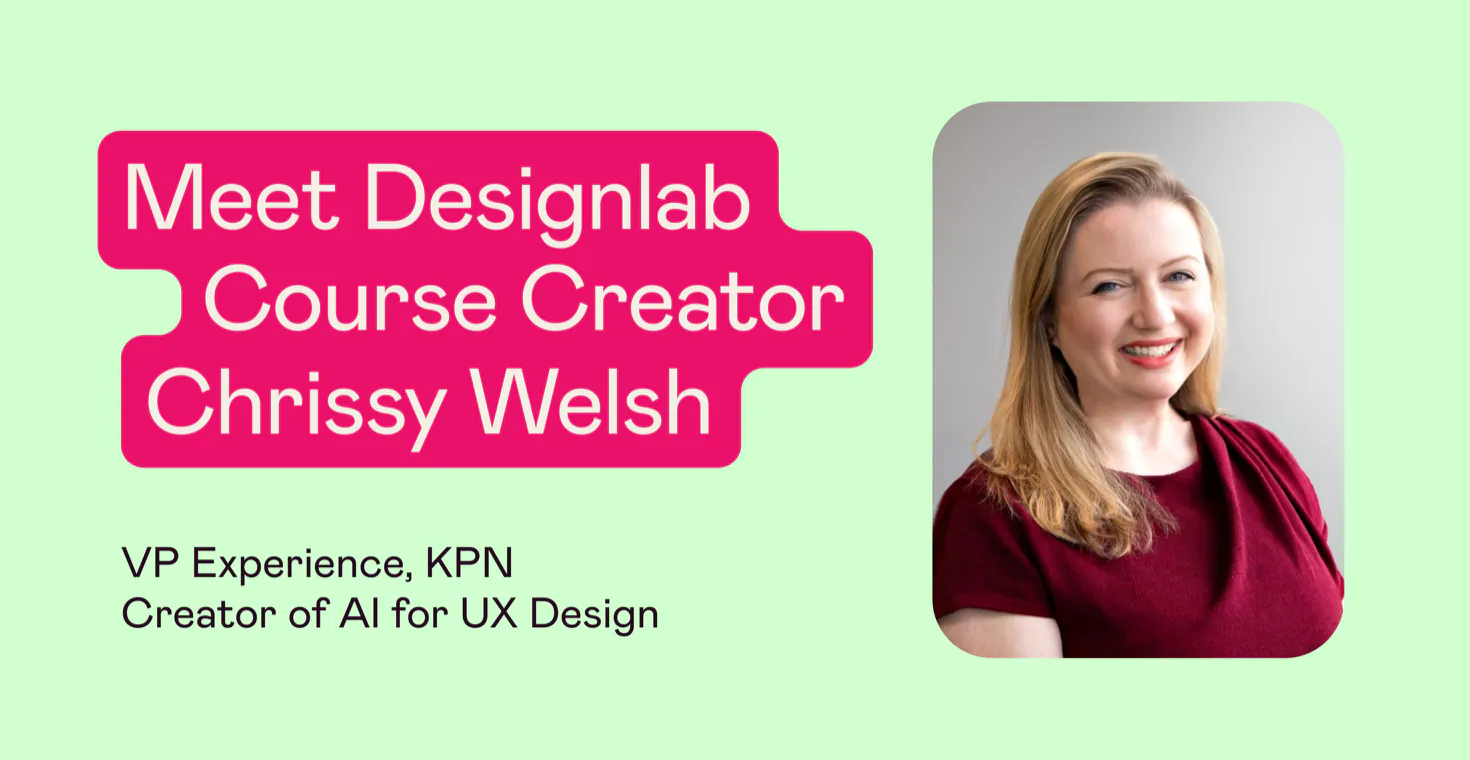


We sat down with Chrissy Welsh, Designlab course creator and instructor for AI for UX Design. Chrissy started embedding AI into design workflows long before LLMs were commonplace. From cancer-detection models at Philips to fraud-detection systems at ING, Chrissy brings 20+ years of industry experience and a passion for the field to Designlab.
We talked with her about how she got here, her vision for AI in UX Design, and what she thinks designers should do to adapt to a changing field.
From Painting to UX
Chrissy never planned to become a UX designer. At sixteen, she set her sights on a fine arts painting program and was crushed when she didn't get in.
What followed was what she calls a “chaotic journey” through digital art, applied graphics, and interface work — including, in the early days, designing CD-ROMs for motorcycle testing. When Chrissy finished college in Glasgow, the field she had been training in was just beginning to gain a name. “The term UX was coined just as I was graduating, but it was called Applied Graphics for Multimedia Technology.”
Her first jobs were in print and editorial design, where she built experience in typography, hierarchy, and storytelling. Then 2008 hit. Chrissy was already feeling a bit untethered, but now, she was out of work, with one possible path forward: leave Scotland.
“I got a contract for one year in Amsterdam, and I thought, ‘Okay, the world's gone really to shit, so I'm going to take the contract in Amsterdam and be there for a year.’ Newsflash, dear reader, it was not one year. I'm now in year 15.”
She landed at a fast-moving startup, working as one of only two designers supporting roughly 30 developers. It was also the moment Sketch was being built. “I got to know the founders of Sketch because we were one of their first few customers.” The rise of the Lean UX methodology, emerging design tools, and the startup pace forced her to build experience quickly.
“It’s been a lot of serendipity and a little bit of tragedy…a lot of working in different fields, all the aspects of design, and just landing in a place.”
Early Exposure to AI
From there, Chrissy moved to Philips, where she became Global Experience Director responsible for a 216-product portfolio.
It was at Philips (and later at ING and Backbase) that Chrissy was first exposed to AI inside a regulated industry. Long before the rise of consumer LLMs, Philips’ teams were using AI for cancer diagnoses.
“They were feeding and training models with large amounts of cancer images. We became more accurate than a doctor in diagnosing cancer based on the screens from Philips MRI machines.”
Chrissy carried that experience to wholesale banking at ING, where the team applied the same principles to a completely different domain. “Instead of being a diagnosis for medical images, it was a diagnosis of financial records. Is your company fraudulent or are they not fraudulent, and can you determine that with data? And turns out you can.”
Seeing what scientists and engineers could do with AI, Chrissy felt designers needed access to the same tools. That idea would eventually become the seed of her Designlab course.
We were a design team working with really smart scientists…and I realized that designers really need these tools.
As LLMs began to emerge, Chrissy and her team started experimenting with them in their workspace. “Some we had created, and some were available on the market. And we quickly could see that the market was outpacing what we could do.” Chrissy led the shift to incorporate new AI tools into her team’s design process while also creating a framework for ongoing use and ROI tracking.
“That became the first round of what this course is. As things progressed and more people wanted this, there was a demand for someone to tell them how to do it with design.”
A Course for Any Design Environment
When Chrissy set out to build Designlab’s AI for UX Design course, what she didn't want was for it to be centered around specific tools.
“I didn't want to make a course that is, ‘These are the tools, and this is how to use the tools,’ because that does designers a disservice, and these tools might not be the ones that you want to use in the future.”
So instead of teaching tools, she teaches a process that applies to any UX or product design environment. Designers leave the course with a working methodology, a range of AI tools they've experimented with, and, crucially, a framework for evaluating AI. Chrissy is clear about the constraints designers face inside large companies. She herself is “golden handcuffed to Copilot,” but she acknowledges that everyone has their own approved tool stack.
I didn't want to make a course that is, ‘These are the tools, and this is how to use the tools,’ because that does designers a disservice, and these tools might not be the ones that you want to use in the future.
Another priority for Chrissy is keeping the curriculum current, an ongoing process that requires her to update the course content every few weeks as tools change.
"Do the Right Thing, and Do the Thing Right"
For all the changes in design tools and trends, Chrissy's foundational principle as a designer hasn't shifted in 20 years.
“Do the right thing, and do the thing right. Do the thing that needs to be done — for the customer, for the user — and then do it right. Don't do it half-measure. Don't do it in a way that it's kind of right. Do it right.”
That principle, she says, applies just as cleanly to AI-augmented design as it did to the human-computer interaction work she trained in two decades ago. The interfaces and the toolkits change. The people behind them don't.
What is shifting, in her view, is how designers should be allocating their time. AI is condensing the design production phase, and Chrissy sees that as an opportunity to put time where it really makes a difference.
“I want to spend one week on design and three weeks on checking instead of spending four weeks on design and hoping it's right at the end. The time is the time, but I want to use it differently.” There's no shortcut to making a thing work for the people who need it, and that's what it means to do the thing right.
What Chrissy Wants Designers to Know About AI
Chrissy sees the biggest challenge for designers in the AI era as failing to realize how much they can do with the tools. Part of her job as instructor and mentor is helping widen the aperture, showing students that if they can describe a project, they can probably use AI to generate it.
“People put their own limitations on what is possible. I cannot get into your brain and show you. You have to experience it for yourself before you believe that you can do it. If you can imagine it, you can prompt for it.”
That's why Chrissy spends so much of her teaching time on demonstrations and deliberately includes failure cases. “You need to build something and have it go horribly wrong for you to be able to understand how to do good quality prompting and building.”
People put their own limitations on what is possible. If you can imagine it, you can prompt for it.
What’s Changing in Design
Despite AI’s impact on design work, Chrissy believes the fundamentals remain unchanged.
“I think the essentials are as they ever were: an understanding of what design actually is and who it should be for, and the empathy with which it should come.”
What she does see growing is the demand for designers who understand behavior. “Behavioral science is something that will increase as a demand for designers — to understand people more and how people behave, because project managers with hands-on design tools are not going to be able to do that as well as we can.”
She also thinks future designers will have a stronger understanding of front-end design. And alongside the rush toward faster, AI-assisted production, Chrissy expects a backlash effect and a rise in handmade design.
I think the essentials are as they ever were: an understanding of what design actually is and who it should be for, and the empathy with which it should come.
Chrissy describes the modern designer as something close to a renaissance figure — someone who can pull together multiple disciplines and ship them as a cohesive experience. And where designers sit in the build pipeline has changed, creating more opportunities to make an impact.
“Before we were always relegated to the concept, and the concept always had to be built by someone else. And now we're so close to the build, a lot closer than we've ever been before.”
Her advice for designers at this juncture is the same advice she gives her students on day one: just try things, let them break, and iterate.
“Perfection doesn't exist, but that's why we have learning, and that's why we make little steps. We have such an important role to play in what the future of digital looks like…no one else is gonna make that.”
Learn AI for UX Design with Chrissy
Want to build a future-ready AI workflow with Chrissy as your guide? Explore AI for UX Design — Designlab's course on integrating AI across the full design process.


.webp)