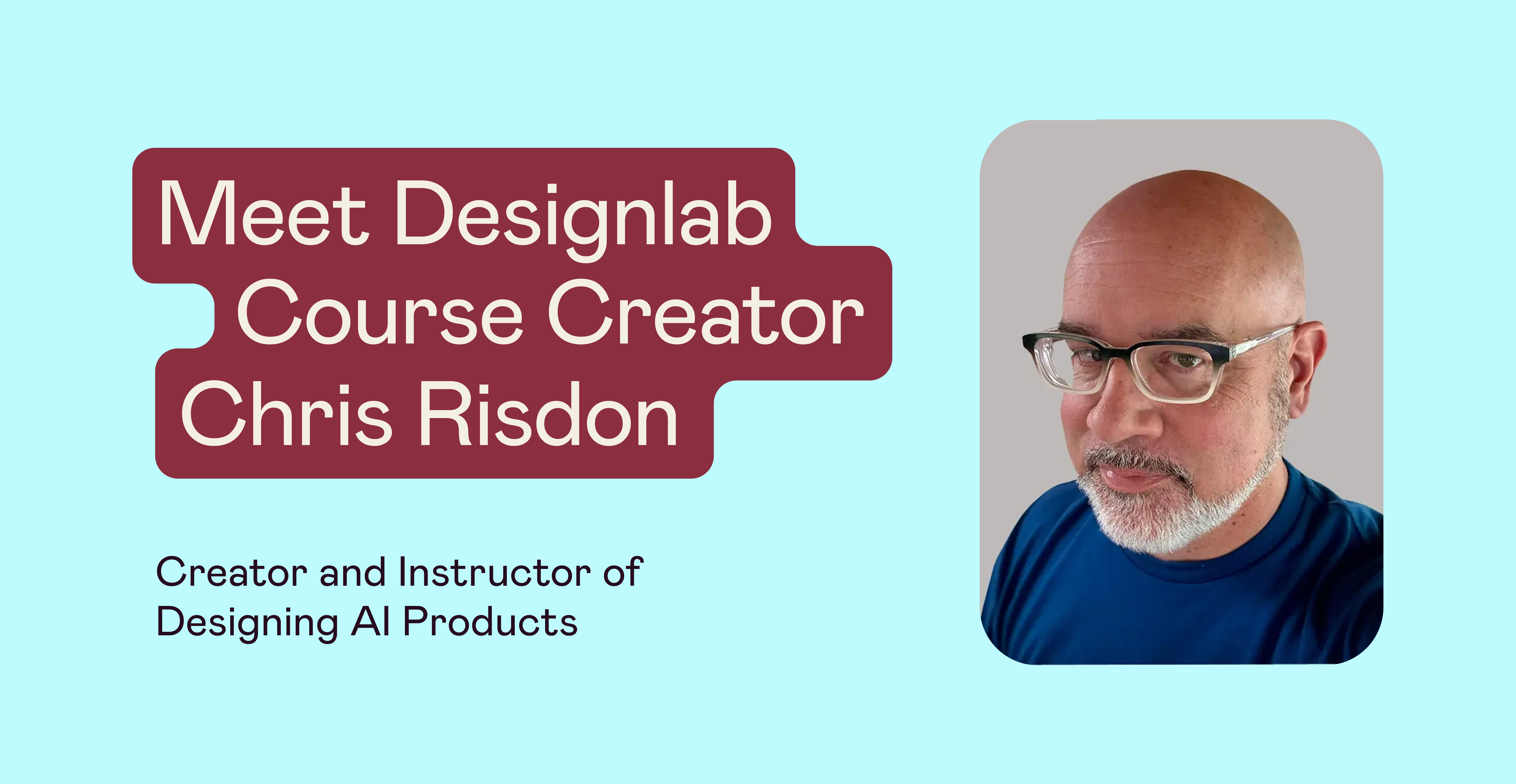


We sat down with Chris Risdon, Designlab course creator and instructor for Designing AI Products. Chris has been working in and around digital design since the mid-90s, from Microsoft and IBM to eBay, Capital One, and UX consultancy Adaptive Path. For the last five years, he's been focused almost exclusively on what it means to design with and for AI inside real companies.
We talked with him about his extensive career, why Designing AI Products fits the current moment, and what he thinks the field now demands of designers.
A Path Through Web, Print, and UX
In the mid-nineties, Chris worked in web production and product management. After a few years, he stepped away to get his MFA in graphic design, which included “scratching an itch” in print and a stint as an editorial designer in New York. Eventually, he found his way back to UX — specifically interaction design, the discipline closest to what was once called human-computer interaction. "That's the flavor I most identify with."
Over the next two decades, Chris worked in startups, large enterprises like Microsoft, eBay, and IBM, and a handful of agencies and consultancies. In 2010, he landed at Adaptive Path, the boutique UX consultancy whose alumni would go on to shape much of the modern design field through books, conferences like UX Week, and companies later acquired by the likes of Google.
When Adaptive Path was acquired by Capital One in 2017, Chris moved into the company's innovation lab as head of design. Since then, he has deliberately oscillated between leadership and individual contributor work so he can stay hands-on.
Getting His Hands Dirty With AI
Around 2021, when generative AI was just hitting consumer consciousness, Chris made a deliberate pivot into the space. "I specifically wanted to start getting my hands dirty with AI."
The motivation, he says, was twofold. Part of it was professional restlessness. At his career level, he could have kept doing solid UX work indefinitely without learning anything new, but he wanted to challenge himself.
The other part was that Chris saw the writing on the wall. He knew AI was going to be something significant. He had already gotten a taste of machine learning while working with small trained data sets at Capital One, but he sensed that something bigger was coming. And he didn’t want to adopt AI blindly. "I wanted to get ahead of it. I wanted to know what's good about AI and what the scary bad stuff will be, so I can know for myself."
He joined IBM's Watson Data and AI group, then moved to Viz AI, a healthcare AI startup. Most recently, Chris spent two years at eBay as their first designer focused exclusively on AI — helping launch their shopping assistant and integrating AI into the core search experience.
Where Service Design Meets AI
One thread that runs through Chris's recent work is how service design applies when AI is the foundation of that service.
Chris’s example of this comes from his work on an AI agent for fast-food drive-thrus. The agent itself was only one piece. Inside the restaurant, staff wore headsets so they could hear the interaction and bail the agent out when it got stuck. There was also hardware to detect approaching cars and software integrations connecting the agent to the restaurant's existing stack.
"There was this multi-touchpoint aspect — human and agent and all these other technology pieces. The AI isn't just a product, like a shopping assistant. It is fully representing a service."
At Viz AI, the picture was similar but higher stakes: an end-to-end clinical workflow that started with a paramedic in the field, ran through ER triage, scans, labs, the operating team, and post-care — stitched together by generative AI and machine vision diagnosing strokes, bleeds, and embolisms in real time. "That really gave me a point of view on applying AI and agentic experiences within a service context."
It’s really interesting to see [through] a service design lens of designing for AI, because the AI isn't just a digital product. It is fully representing a service.
Designing for AI Means Thinking Strategically
Ask Chris what good AI design looks like, and he'll say it starts with matchmaking. “Don’t just apply AI because you can apply AI.”
For Chris, designing AI products requires understanding when AI actually improves an experience, what tradeoffs it introduces, and how to articulate its value strategically.
He compares this moment to the arrival of mobile design in the late 2000s, when designers suddenly had to rethink interaction models around gestures, touch, and responsive layouts. AI introduces its own new considerations: probabilistic responses, agentic behavior, disclosure, and the reality that two users can ask the same question and receive two different — but equally valid — answers.
But learning the mechanics alone isn’t enough. “You do have to understand what’s happening so you can differentiate yourself. Everyone is going to be designing for AI.”
Everyone is going to be designing for AI. You need a bit of the theoretical [understanding] so you can differentiate yourself.
Chris argues that the designers who stand out will be the ones who combine practical fluency with deeper theoretical understanding — the same way strong graphic designers understand typography or Gestalt principles before breaking the rules.
Ultimately, he sees strategic thinking as the real differentiator.
“You always have a backlog of opportunities. You have to make the strategic case: ‘From a user need, we can map that…if we use this AI here, it would improve our ability to meet that need.’ If you can’t articulate it at the strategic level, you’re just slapping the patterns and principles around.”
Why This Moment Matters for Designers
Designlab’s launch of Designing AI Products comes at a key moment for mid-to-senior designers and product people who are being increasingly expected to develop deeper AI expertise.
Chris sees the industry restructuring in real time, with AI absorbing more production-level work while making strategic design thinking even more valuable.
“The seniors are the ones who can connect the dots across an ecosystem — and that’s where AI applied at a service level gets really hard.”
Chris sees AI as many others do: as a thinking partner that accelerates execution while increasing the importance of human judgment, systems thinking, and experience strategy.
The teams that have built up heuristic knowledge — we’ve seen this work, we know how to find what problem to solve — those are the teams that will have the advantage.
That’s also part of why he teaches.
He strongly believes that designing for AI is one of the hardest things to learn on your own. He's had the privilege of focusing on it full-time, while most designers will be tasked with it as part of their normal work, with no runway and limited resources to figure it out.
“It would be hard to do this ad hoc. Like, ‘Here’s a new project — apply AI to this problem space.’ And then you’re like, ‘Okay, I’ll go look at some YouTube videos.’”
Ultimately, Chris wants designers to have a leg up from someone who’s seen a bit of everything.
"I'm not just bringing a bunch of facts. I've thought about this a lot. I've thought about the theory and how to map it to practical application. I'm interested in sharing that, whether it's through a blog post or working in a classroom."
Explore Designing AI Products
If you’re interested in diving into the frameworks, patterns, and craft behind great AI products, explore Chris’s Designing AI Products course.


.webp)