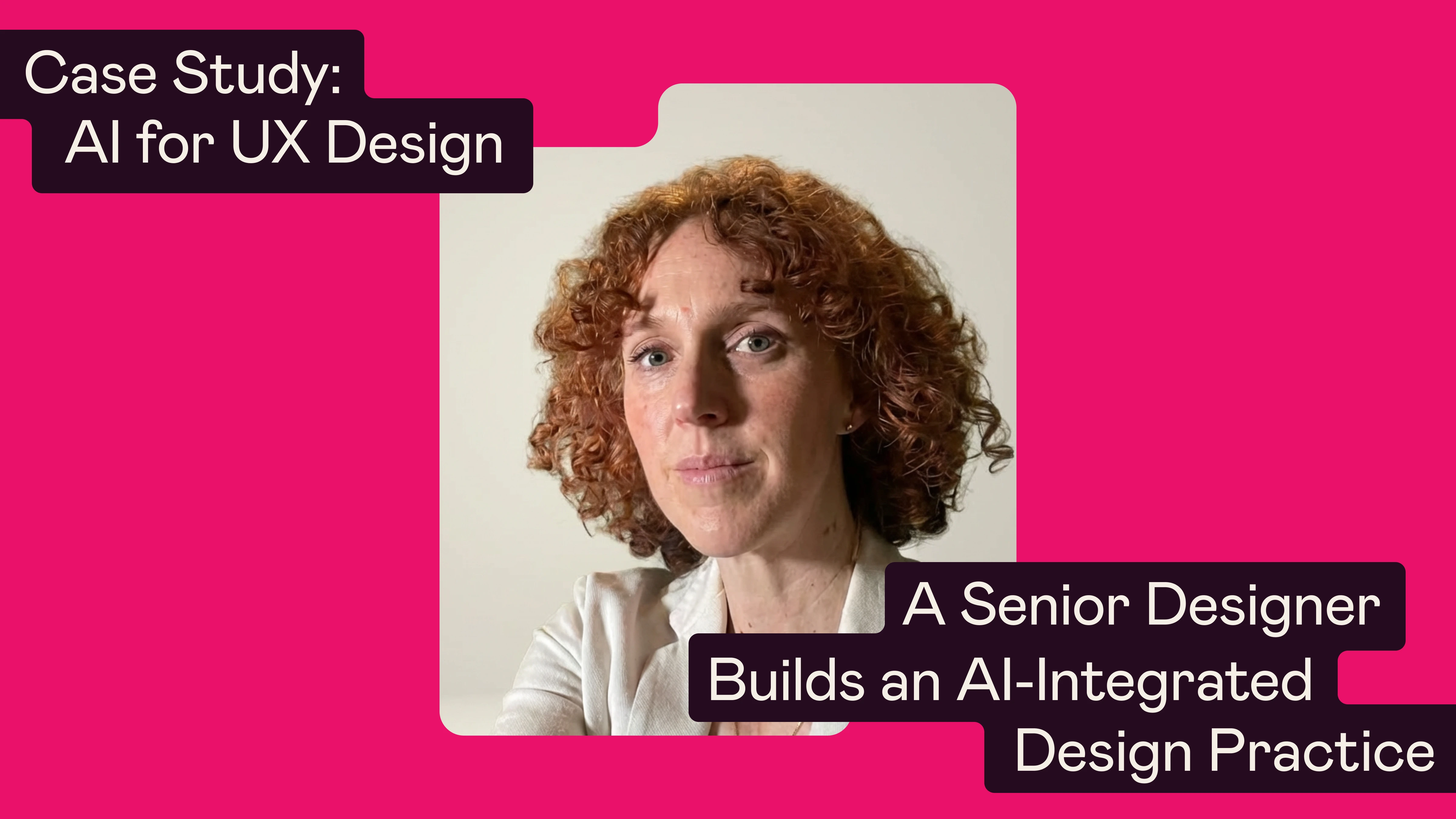


After a decade working as a senior UX designer at IBM, Gillian shifted to freelance work and found herself navigating a fast-changing design landscape shaped by AI. Although she was looking to learn more about AI product design, she enrolled in Designlab’s AI for UX Design course, which gave her exactly what she needed: hands-on exposure to AI tools across the entire design workflow.
The result was a major boost in confidence, a more experimental mindset, and a new way of working with AI that she’s actively building on today.
The Space to Dig Deeper Into AI
Before taking the course, Gillian was designing user interfaces for cybersecurity at IBM.
With that level of experience, she wasn’t new to design—or even to AI. But her exposure to AI tools had been casual and unstructured.
“The course exposed me to all of these tools that I might have loosely known about, but I had never had the impetus to really dive in, to force myself to take the time to use them.”
While she came into the course with different expectations about what she might learn, she quickly realized that learning to integrate AI into her workflows was a great fit for where she was in her career.
“I thought, you know what? This is just what I need right now—to practice. And I learned a lot.”
The course exposed me to all of these tools that I might have loosely known about, but I had never had the impetus to really dive in, to force myself to take the time to use them.
A Reality Check and a Confidence Boost
What surprised Gillian most was how much she didn’t know, and how valuable it was to be pushed into hands-on practice.
“I had thought that I already knew all this stuff. But then I [realized], oh no, I don’t know anything.”
The course forced her to go beyond theory and use the tools in context. By the end, she had built not just awareness, but real working knowledge and confidence. She now approaches AI with clarity and intention, and she knows which tools to use in a given situation.
Most importantly, instead of thinking about AI as a single tool, she began to see it as something embedded across the entire design process.
It’s a total infusion of AI into your design process—every aspect of it.
Structured Learning That Appealed to Her Agile Mindset
Gillian was excited to discover how deeply AI could apply to various aspects of her work. The curriculum didn’t focus on pairing individual tools with single uses, like image generation or prototyping, but rather on learning to use AI holistically across workflows, research, organization, and more.
“There were all these levels that were really great to be exposed to. It was really kind of crazy, like a candy shop situation.”
This broad exposure was paired with a structure that pushed her to actually use the tools—not just learn about them.
As someone who has worked primarily with engineers in agile development contexts, the course’s weekly format—lessons, exercises, and projects—along with opportunities to reflect and review each section, kept her moving forward while reinforcing key ideas.
Just as importantly, it helped her break out of a familiar pattern: overworking and over-polishing.
“I had a tendency to want to go down a rabbit hole…like this has to be perfect. And then I decided, just for this course, I'm going to let AI tell me what to do. And I've never had that experience before.”
Pressure-Free Experimentation and Guided Feedback
Gillian felt that the course struck a good balance between freedom and support, creating a low-pressure environment that encouraged experimentation and iteration.
The freedom made it easier for Gillian to try new tools, move quickly, and focus on learning rather than polishing every project. “During the exercises I was less afraid of learning about AI because it was in the aegis of learning. I probably would have been too frightened to do this professionally until I took this course.”
At the same time, mentorship from Elizabete Staerfeldt provided just enough guidance to keep her on track without overloading her with critique.
“[She said] it was more about thinking rather than the product itself.” That reframing helped her understand that designing with AI isn’t about polishing outputs but about directing the process.
“It's always good to have a reinforcement of design thinking. Very few people have the opportunity to go through that loop because most of us are doing one little thing.”
The result was a learning environment that felt both supportive and empowering—giving her the confidence to experiment, while reinforcing the right mental models along the way.
I was less afraid of learning about AI because it was in the aegis of learning. I probably would have been too frightened to do this professionally until I took this course.
Starting Small, Building Momentum
For Gillian, AI for UX Design had an unexpected impact, helping her move from passive awareness to active, informed use of AI.
She’s now comfortable using AI tools, and the course has sparked creative momentum and given her a new mindset about the future. “The work I did at Designlab is forcing me to be creative and put myself out there.”
What started as a desire to better understand AI has evolved into a shift in how Gillian works—approaching AI-integrated design with more confidence and curiosity, and continuing to build and grow her AI expertise as she explores what’s next.


.webp)