.png)


📰 3 THINGS TO CHECK OUT
- UX Pioneer Jakob Nielsen points out that most companies are using AI to speed up individual tasks, but the real impact comes from redesigning entire workflows. In a large-scale experiment, startups that restructured how work gets done saw dramatically stronger outcomes, including higher growth and revenue.
- The shift is moving from local optimization to system-level thinking. Instead of improving isolated steps, high-performing teams use AI to remove handoffs, parallelize work, and automate entire sequences. For designers, this is a major expansion of the role.
- “A plausible next practice is the emergence of a dedicated role… call it a workflow architect. This person would map dependencies, identify where AI reduces one constraint and creates another, define exception logic, and coordinate redesign across teams."
How To Improve UX In Legacy Systems
- UX expert Vitaly Friedman breaks down why legacy systems—while messy, outdated, and often frustrating—are still critical to business operations, and why redesigning them doesn't have to mean starting over.
- Instead of a full, risky redesign, the most effective approach is incremental, systems-level thinking: mapping workflows, understanding dependencies, and improving high-impact moments over time. In legacy environments, even a single broken step can undermine the entire experience.
- “You’re migrating not just components, but users and workflows. Because you operate on the very heart of the business, expect a lot of attention, skepticism, doubts, fears, and concerns.”
What Is the AI Research Risk Cascade? Experts Explain
- User Interviews Community Director Nick Lioudis unpacks a growing challenge in AI-assisted research: small errors in transcription, synthesis, or analysis can compound into misleading insights and ultimately break down pipelines.
- The takeaway, according to leading researcher Lindsey DeWitt Prat, is to use AI more intentionally, and to not rely only on one-time audits. Evaluate outputs stage-by-stage, compare results across tools, and define what is most critical to moving forward, since not all research has the same risk profile.
- The designer's role is now less about generating outputs, and more about judgment, validation, and stewardship of insights. This is exactly what our AI for UX Design course focuses on—how to work with AI as a collaborator while maintaining rigor, context, and craft.
💜 PORTFOLIO INSPIRATION
Molly Smith is a product designer whose work sits at the intersection of complexity and care. With experience in healthcare and edtech, she brings a systems-thinking mindset to messy, real-world problems. In her UX Academy project RotaWiz, she tackles the fragmented, high-stakes experience of hospital scheduling, designing an AI-assisted rota tool that unifies scattered systems and helps doctors complete key tasks up to 96% faster. In ALT-R Studio, she shifts gears to design a launch-ready website for a Pilates studio, focusing on trust, clarity, and helping users make confident decisions in an unfamiliar space. Across both projects, Molly’s work reflects a thoughtful balance of user needs, business realities, and technical feasibility—creating products that feel calm, credible, and genuinely useful.

Got a portfolio you love that you’d like to share with our audience? Email your suggestions to hello@designlab.com.
💡 INTERESTING STUFF...
- The NY Times Gets a Redesign
- Berlin Design Week 2026
- The Future of UI Design is Agentic Design
- Pencil Launches Code on Canvas
Digital design is like painting, except the paint never dries. — Neville Brody, graphic designer and art director
🧪 FROM THE LAB
Join the Next Cohort of AI Prototyping Camp
AI Prototyping Camp launches April 30. In this hands-on program for designers, PMs, and builders, you’ll go beyond static screens to build interactive flows using tools Figma Make and Lovable. Refine flows, test new ideas more rapidly, and collaborate more effectively in AI-accelerated environments. Grab your seat here.
Mastering Creative Direction in AI for Visual Design
AI for Visual Design launches in two weeks, on May 1st. This reimagined course teaches you to harness AI tools and create repeatable systems to generate, refine, and scale visual work—while developing the creative direction skills to stay in control of the output.
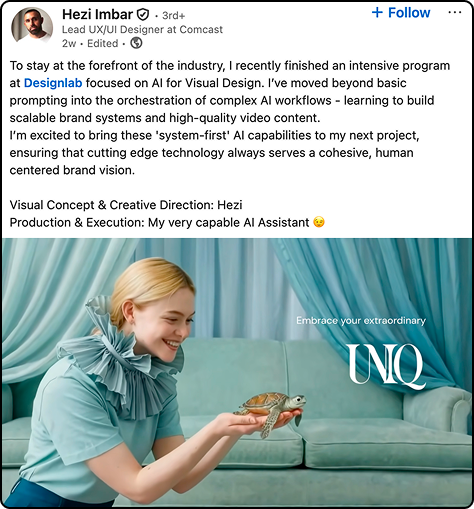
Comcast UI designer Hezi Imbar shared his recent experience in the course, where he shifted from feeling behind on AI to being empowered and eager to transform his daily work. 👉 Read his story.
Ready to join the next cohort? Enroll now.


.webp)