


Table of Contents
What is a UX Design Certification?
Best UX Design Certificates For Early Career Designers
2. Springboard’s UX Design Bootcamp
3 Google’s UX Design Professional Certificate
4. Flatiron
5. Ironhack
6. Nielsen Norman Group’s UX Certificate
8. Interaction Design Foundation
9. BrainStation
Best UX Design Certificates For Experienced Designers
1. AI Product Design Certification
What is a UX Design Certification?
A UX design certification is a valuable qualification for anyone seeking employment as a user experience designer or looking to advance their existing skills.
For beginners, certification programs can provide the practical skills needed for entry-level UX designer roles and prepare learners to address real-world challenges in digital design. More experienced designers may also pursue advanced certifications to deepen their expertise, develop specialized skills, qualify for new responsibilities, or strengthen their case for promotion. A UX design certification is often part of a structured certificate program designed to provide essential knowledge and skills in UX design.
A reputable UX certification for early career designers should provide a complete understanding of user research, design principles, prototyping, usability testing, visual design, accessibility, collaboration, tools and software, portfolio development, industry trends, and community connections.
UX or product design certifications for experienced designers are often topical in nature and focus in on particular area or facet of design or the design process.
Many UX design certification programs allow learners to complete courses at their own pace, providing flexibility and support.
Key Takeaways
Various organizations provide UX certification courses, each offering differing levels of support to their students. Thorough research is crucial to identify the right UX certificate for you.
Best UX Design Certificates For Early Career Designers

1. Designlab’s UX Academy
Duration: 36 weeks (20 hrs/week part time) or 21 weeks (40 hrs/week full time)
Cost: $8,499 (payment plan options and long-term financing are available)
Designlab is an online educational institution that offers multiple industry-leading programs in User Experience Design. Designlabs’s UX Academy is a comprehensive, fully online bootcamp suitable for learners who are complete beginners, as well as those with existing design experience. Students who are to design begin with UX Academy Foundations, a flexible beginner-friendly program meant to introduce students to both foundational design concepts and Designlab’s form of teaching. With UX Academy, students have the option to study full-time for 21 weeks, part-time for 36 weeks, or through a self-paced option over 18 months.
The curriculum is holistic, covering the entire UX/UI Design process through hands-on project work and guided, 1:1 mentor support. In the middle of the program, students go through an intensive, project based module called UI Accelerator, where they refine their UI skills through project-based practice and iteration. Graduates complete four portfolio projects, two of which are end-to-end, which are then assembled into a polished portfolio that demonstrates both skills and experience. Portfolios also include at least one real-world project through Designlab's Client Capstone program. User-centered design is a core principle emphasized throughout the curriculum, ensuring students create rich interactive experiences and usability studies.
Expert, 1:1 Mentorship is a major aspect that sets UX Academy apart from other design certificates. Mentorship is the key to personalized learning and professional growth, and Designlab goes the extra mile by ensuring students are paired with a mentor suitable for their learning style and needs.
All graduates of Designlab’s UX Academy will receive six months of support through 1:1 career coaching and a career-focused curriculum. Additionally, eligible students are backed by Designlab’s Tuition Reimbursement Policy, which provides a tuition refund if a graduate is unable to find a job within six months. This commitment underscores Designlab’s confidence in their program and their dedication to student success. Find out more about how Design Lab can help you begin your UX career here.

2. Springboard’s UX Design Bootcamp
Cost: $7,190
Duration: 6-9 months
Springboard is an online learning platform that offers a comprehensive UX bootcamp. This course, typically completed within a 6-10 month timeframe, provides an immersive, project-based learning experience. Students receive one-on-one mentorship from industry professionals, gaining insights and personalized feedback into their work.
Throughout the course, students build a robust portfolio that showcases their skills. UX research plays a crucial role in planning and conducting usability studies, synthesizing research results, and modifying designs based on research insights.
After becoming UX certified, Springboard continues to support students in their career journey, offering up to six months of dedicated career services. One of the standout features of Springboard is their job guarantee. If a student meets all the job search requirements but is unable to secure employment, Springboard offers a refund of the tuition, demonstrating their commitment to student success and their confidence in the effectiveness of their curriculum and career services.

3. Google’s UX Design Professional Certificate
Duration: 6 months
Cost: $49 per month with a Coursera subscription
Google’s UX Design Professional Certification is a budget-friendly and flexible program. The total cost being can be under $200 if you stay on track, and students can progress through the course at a pace that suits them.
The course offers a curriculum spanning from fundamental to more advanced design concepts and practices that individuals will need for a UX role. It’s tailored to assist both novice and intermediate UX design professionals in gaining a comprehensive understanding of UX design. The Google UX Design Certificate has no prerequisites, and provides a flexible learning format with various resources upon completion.
The program does guide students in building a portfolio, which is a crucial asset in the UX design field. This allows students to showcase their skills and projects to potential employers.
However, it’s important to note that the program does not offer mentorship, post-graduation employment support, or any kind of a tuition reimbursement policy. When compared to other programs, the Google UX Design Certificate is more affordable but lacks some of the support services offered by competitors, meaning it may be best for individuals who are incredibly self-motivated or already have some existing design experience

4. Flatiron
Duration: 15 weeks
Cost: $9,900
Flatiron UX Design Bootcamp is a comprehensive program that offers training in UX/UI design. It provides mentorship and post-graduation employment support, helping students transition into the industry. Students build a portfolio of projects, showcasing their skills to potential employers.
The certification offers both online and in-person learning options, with full-time and part-time courses. The duration varies, with the full-time course lasting around 15 weeks and the part-time course taking up to 40 weeks. It’s a solid choice for those looking to gain practical skills in UX/UI design.

5. Ironhack
Duration: 9 weeks (full time) or 24 weeks (part time)
Cost: $7,364
Ironhack’s UX certification is aimed at training aspiring UX/UI designers. The course can be completed in 9 weeks full-time or 24 weeks part-time. It offers mentorship, post-graduation employment support, and helps students build a portfolio.
While they don’t have a tuition reimbursement policy, they do reportedly have an income share agreement program. This UX/UI certification is available both online and in-person in various cities worldwide and may be a great option for aspiring UX designers who prefer to learn in -person.

6. Nielsen Norman Group’s UX Certificate
Duration: 30+ hours
Cost: $6,300
The Nielsen Norman Group, also known as NN/g, is a renowned consulting firm based in the United States that focuses on user UI/UX certification. The company was established in 1998 and since has made significant contributions to the user experience design industry, including coining the term “user experience”.
This certification requires participants to complete a total of 5 full-day training courses offered by the Nielsen Norman Group. Each course must be followed by passing an exam to earn a course certificate. All of the five course certificates must be earned within a 3-year period to achieve the UX Certification.
Neilsen Norman also recently added a UX Master Certification, where individuals can take an even more intensive route with their UX education. The program is similar in structure and learning format to the shorter option. However, with the Master Certification program, learners take a total of 15 trainings, totaling over one hundred hours. There is also a significant price discrepancy: the cost for the Master Certification is $18,100.
While highly respected for its comprehensive curriculum and industry recognition, The Nielsen Norman Group’s certificates lacks mentorship, post-graduation support, tuition reimbursement, and portfolio building opportunities. These gaps could impact students’ career progression.
7. Cornell University (eCornell) UX Design Certificate
Duration: 5 months (8–10 hours/week)
Cost: $3,750
Cornell University’s UX Design certificate (offered through eCornell) is a fully online program that provides a structured, step-by-step introduction to user experience design through a series of instructor-led courses focused on human-centered design. It’s designed for a wide range of participants, including aspiring UX designers, product professionals, and business or marketing specialists looking to strengthen their UX skills.
The program emphasizes practical UX methods like user research, personas, prototyping, and usability testing, helping learners build a strong foundation and produce a final prototype that can support portfolio development. Courses are completed in sequence and include guided feedback and peer discussion in a cohort-style format.

8. Interaction Design Foundation
Duration: 22 individual courses, lengths vary
Cost: $22/month membership (paid annually)
The Interaction Design Foundation is a leading online design school offering a variety of courses in UX, with a total of 22 courses recommended for their “UX Designer” learning pathway. Students who wish to participate will find the recommended course layout on their website, with each course laddering up to the next. The Interaction Design Foundation’s courses are taught through video lectures featuring industry experts, and students will also work through lessons and projects that are graded by an industry expert.
The Interaction Design Foundation doesn’t offer live mentorship, but there is a community of learners that students can tap into for networking and community connection. Additionally, the courses are fully asynchronous and self-paced, which makes them a great option for those who are looking for a highly flexible learning environment. While Interaction Design Foundation doesn’t offer a tuition reimbursement policy, members can take as many courses as they want at no additional cost other than their membership fee.
9. BrainStation
Duration: Flexible depending on time commitment
Cost: $16,500
BrainStation’s UX Design Bootcamp is a part-time, cohort-based program delivered online that blends live instruction with hands-on projects to help learners build professional UX skills and a portfolio of work. It’s designed for career changers and working professionals who want to deepen their understanding of UX design, from user research and strategy to wireframing, prototyping, and usability testing using industry-standard tools like Figma.
The bootcamp emphasizes practical, project-based learning with ongoing feedback from experienced instructors, and includes 1-on-1 career support to help learners prepare for the UX job search.
Best UX Design Certificates For Experienced Designers
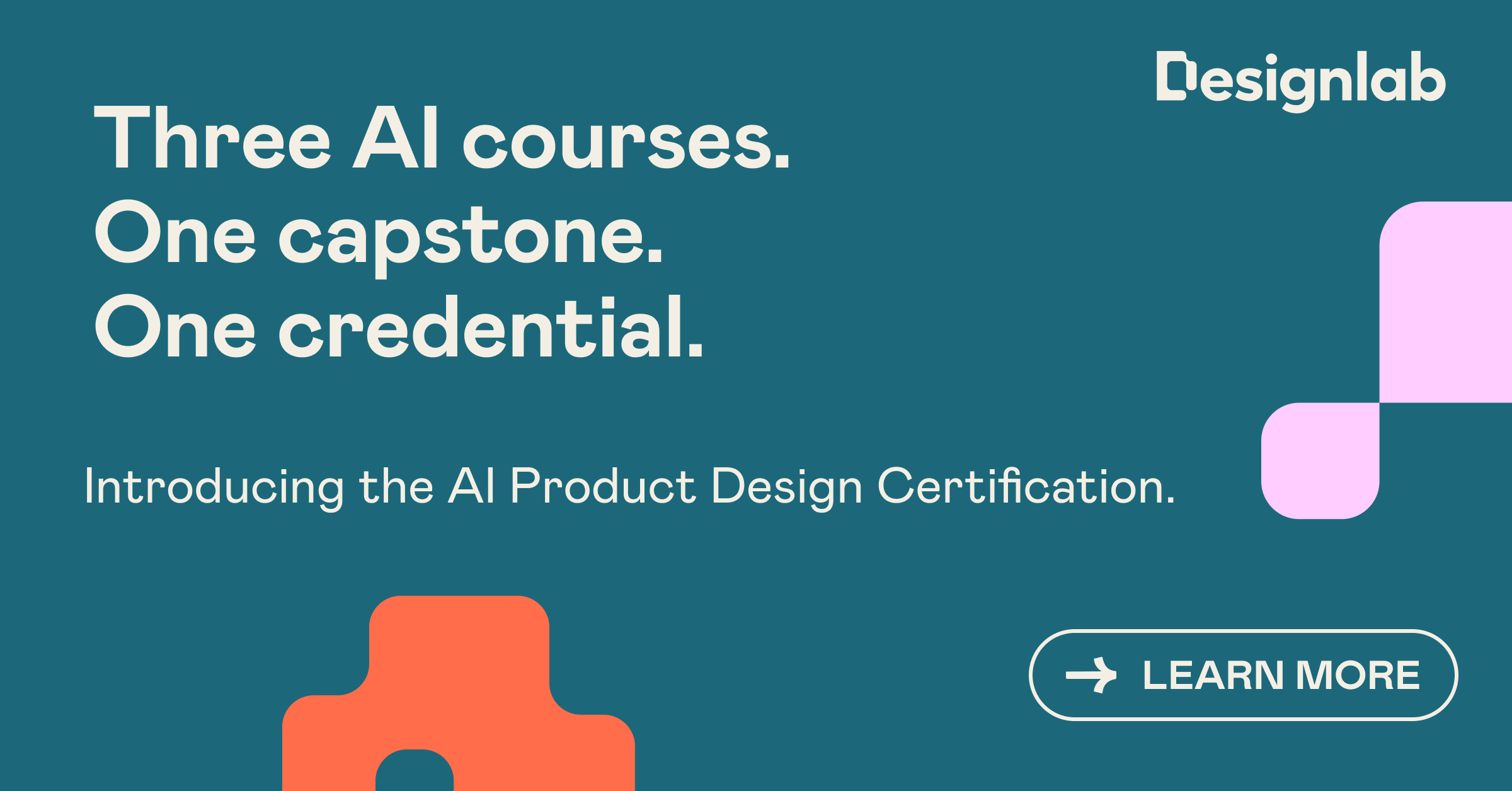
1. AI Product Design Certification (Designlab)
Duration: 3–4 months typical (up to 12 months to complete)
Cost: $2,195 (Design Track) or $2,695 (Design + Build Track)
Designlab's AI Product Design Certification is an advanced credential built for working UX and product designers who want to develop real, applied AI capability rather than scattered tool experimentation. It brings together three of Designlab's most popular AI courses — AI for UX Design, AI Prototyping Camp, and Designing AI Products — into one coherent program, capped by a self-directed capstone available only to certification students.
The program is built around two intertwined skills: designing with AI in your day-to-day process, and designing for AI as the core material of modern products. Each course is created in partnership with working practitioners, including instructors who've led AI design work at companies like IBM, eBay, and Lowe's. A Design + Build Track adds Vibe Coding Camp for designers who want to extend beyond design into shipping functional software with AI-native tools.
The certification culminates in a mentor-supported capstone where you design an AI-powered product or feature end-to-end while documenting your AI-augmented workflow, producing a portfolio-defining case study. It's not an introductory program — students should bring solid UX or product fundamentals, though no prior AI experience is required. Designers who've already taken one of the included courses can enroll with credit for prior coursework at alumni pricing.
2. Advanced Design Craft (Designlab)
Duration: 8 weeks
Cost: $1,999
Designlab's Advanced Design Craft Certification is a studio-style program for experienced designers who want to sharpen their eye and push past the mid-level plateau. Built for professionals with at least two years of UX, UI, or product design experience, it focuses on the judgment, polish, and visual precision that separate "good enough" work from genuinely great design — the qualities that become more valuable, not less, in an AI-powered world.
The program runs on a studio model that blends rich asynchronous coursework with live engagement. Each week, students complete hands-on project work and join a 90-minute small-group critique session (6–8 designers) led by a senior Designlab Design Fellow, plus two 1:1 mentor sessions over the eight weeks. The curriculum scaffolds the elements that make products feel special, spanning UI polish, layout and structure, and clarity and usability — from micro-typography and visual hierarchy to flow patterns and feedback loops.
Students work through four progressively challenging projects before a self-directed capstone that pulls everything together into a portfolio-worthy case study. The result is a credential that signals advanced craft and system-level fluency — and a stronger body of work to make the case for a senior or staff-level role. Plan for roughly 10–12 hours a week.
3. UX Master Certification (Nielsen Norman Group)
Duration: 100+ hours of training across 15 courses (completed within 3 years)
Cost: $18,100
For experienced designers looking outside Designlab, the Nielsen Norman Group's UX Master Certification is among the most recognized senior-level credentials in the field. NN/g — the consulting firm founded in 1998 that helped coin the term "user experience" — offers this as the more intensive route beyond its standard UX Certification, requiring 15 full-day training courses totaling over one hundred hours, each followed by an exam, all completed within a three-year window.
The training is research-led and grounded in decades of usability work, covering a broad range of UX topics with the depth and rigor the firm is known for. It's a strong fit for designers who want a widely respected, name-brand credential and who thrive in a self-directed format built around individual courses rather than a single cohort.
It's worth noting the tradeoffs: at $18,100 it's a significant investment, and the program is structured around lectures and exams rather than mentorship, cohort critique, or portfolio development. For designers who value hands-on feedback and a portfolio-defining final project, a studio- or capstone-based program may be a better fit — but for those who want the recognition of the NN/g name, it remains a benchmark credential.
FAQ’s
Can I get a UX job with just a certificate?
Yes, it’s possible to land a job with just a UX design certificate but it often depends on various factors. This certificate equips you with the foundational knowledge and skills required in the field. However, it’s important to note that a strong portfolio and practical experience are also vital. While a certificate can open doors, your success in securing a job will largely depend on your grasp of UX principles, your ability to showcase this through your portfolio, and your performance in interviews. Discover 10 industries currently hiring UX designers.
Can I learn UI/UX in a month?
Learning the basics of UI/UX design in a month is possible, but mastering the field typically takes longer. It requires dedication, practice, and continuous learning. Understanding user behavior, design principles, and how people interact with digital products is crucial. While you can start learning the fundamentals and even some practical skills in a month, becoming proficient usually involves ongoing study, resources and real-world experience.
Are UX courses worth it?
Absolutely, UX courses, such as those offered by Designlab, can be a valuable investment. Designlab offers online design bootcamps that teach UX/UI design skills through part-time, engaging courses. These courses are project-based and include 1-on-1 mentorship from expert designers, which can help you master the techniques needed to design stunning web and mobile products.
Is it hard to get UX Jobs?
Landing a UX design job can be challenging due to competition, the need for experience, and the requirement of a strong portfolio—but it's important to keep in mind that competitive aspects of landing a role will be true in every field. Also, with the rising demand for UX designers, proper training, a well-curated portfolio, and effective networking, it’s entirely possible to secure a position in this field. Persistence is key in any job search. Good luck!
Is a UX certification worth it for experienced designers?
It can be, but the value looks different than it does for beginners. If you already have a few years of experience, you're not using a certification to break into the field — you're using it to deepen a specific capability, signal that skill to employers or clients, and produce work that strengthens your portfolio. The most useful advanced programs are ones that build a concrete skill set (like AI fluency or visual craft), include feedback from senior practitioners, and culminate in a portfolio-worthy project rather than just a completion badge. A credential on its own won't move your career, but the learning and the work behind it can. Programs like Designlab's AI Product Design Certification and Advanced Design Craft Certification are built specifically with experienced designers in mind.
What's the difference between a beginner UX certificate and an advanced certification?
Beginner certificates and bootcamps are designed to take someone with little or no experience and equip them with the foundational skills needed for an entry-level UX role — user research, design principles, prototyping, and a first portfolio. Advanced certifications assume you already have those fundamentals and focus instead on sharpening a particular edge: design judgment and craft, AI capability, data-driven thinking, or systems-level fluency. They tend to be shorter and more focused, often run in a studio or cohort format with critique from senior designers, and are aimed at designers looking to earn a promotion, move into a more senior role, or stay competitive as the field evolves. If you have two or more years of experience, an advanced certification is usually the better fit.
Resources:
The 14 Best UX Design Courses (For Beginner & Experienced Designers)


.webp)

.webp)


